
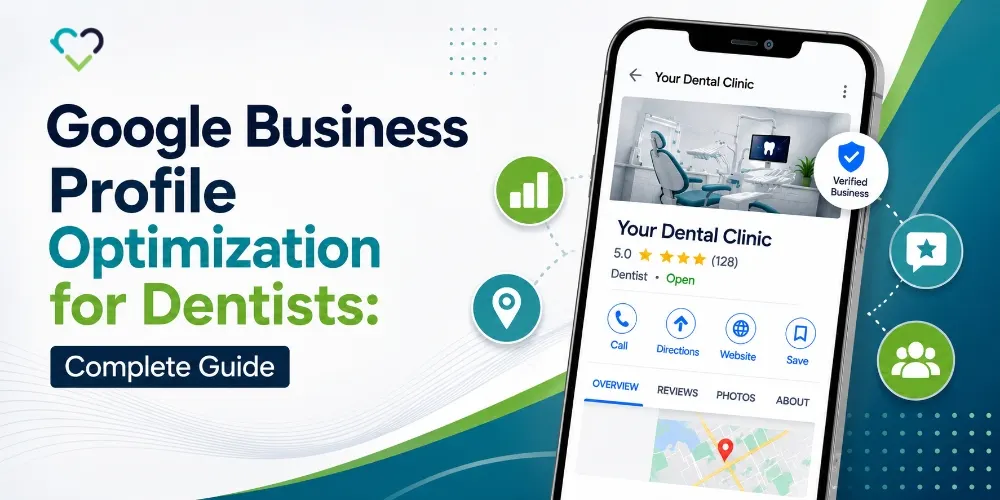
A patient searching for a dentist may not begin on a dental website. They may start with Google Maps, a “dentist near me” search, or a query such as “emergency dentist open today.” In many cases, the first information they see is a Google Business Profile.
That profile can influence whether the patient calls, checks directions, reads reviews, visits the website, or chooses another practice. This is why Google Business Profile optimization for dentists remains one of the most important local marketing tools for dental practices in 2026.
A complete profile does more than display an address and phone number. It helps Google understand the practice, gives patients useful information, and creates a shorter path from local search to an appointment inquiry.
What Is Google Business Profile Optimization?
Google Business Profile optimization is the process of improving and maintaining the information that appears for a business in Google Search and Google Maps. For a dental practice, this includes the clinic name, address, phone number, hours, categories, services, photos, reviews, posts, appointment links, and other available features.
The goal is not to place keywords in every field. It is to give Google accurate information and help prospective patients understand what the clinic offers, where it is located, and how to contact it.
A well-managed Google Business Profile for dentists supports two priorities:
- Helping Google match the practice with relevant local searches
- Helping patients feel confident enough to call, book, or visit the website
Local visibility is generally influenced by relevance, distance, and prominence. A practice cannot control how far it is from every searcher, but it can improve the accuracy, completeness, and usefulness of its profile.
Why Google Business Profile Matters for Dental Practices
Greater Visibility in Google Maps
A properly managed profile gives a clinic a stronger foundation for appearing in local results and Google Maps for dentists.
Google needs clear information about what the practice is, where it operates, and which services it provides. A general clinic that also offers dental implants, emergency dentistry, and children’s dentistry should make those services easy to find.
Optimization does not guarantee a top ranking. However, accurate categories, complete details, relevant services, strong reviews, and a trustworthy website can help Google understand when the practice may be a suitable result.
Stronger Local Search Presence
A dental Google Business Profile works alongside the website rather than replacing it.
The profile provides quick information, while the website gives patients and search engines more detail about treatments, dentists, locations, technology, and the patient experience.
When both assets support the same message, the practice creates a more consistent local presence. The clinic name, address, phone number, hours, services, and location information should match wherever they appear online. Learn more in our Local SEO for Dentists guide.
Better Patient Trust
Patients often compare several practices before booking. A profile with current hours, recent photos, clear service information, and thoughtful review responses usually feels more dependable than a listing that appears incomplete.
Reviews can help prospective patients understand what to expect. Practices should request honest feedback without incentives and respond professionally without revealing private information.
More Appointment Opportunities
An optimized profile reduces the number of steps between a local search and an inquiry. Patients may be able to call, request directions, visit the website, or use an appointment link directly from the profile.
Profile optimization should therefore support conversions, not only rankings. A visible listing can still underperform if its contact details are wrong or its links do not work.
Key Elements of an Optimized Profile
Accurate Business Information
Start with the essentials:
- Use the real clinic name shown on signage and branding
- Enter the correct address and map location
- Add the main phone number used by the practice
- Display accurate regular and holiday hours
- Link to the most relevant location page
Do not add phrases such as “best dentist” or “emergency dentist” to the business name unless they are part of the clinic’s real-world name.
For multi-location practices, each eligible location should have accurate information and a corresponding website page.
Primary and Secondary Categories
The primary category tells Google what the business mainly is. Choose the most specific category that accurately represents the practice.
Secondary categories should reflect services genuinely offered. Adding every available dental category may make the profile less focused rather than more competitive.
Dental Services
Add the treatments the clinic actively provides and use clear patient language.
Examples may include:
- Dental exams and cleanings
- Emergency dentistry
- Dental implants
- Root canal therapy
- Invisalign treatment
- Teeth whitening
- Children’s dentistry
Service information should match the website. Keep descriptions brief, useful, and free of repetitive location keywords.
Current, High-Quality Photos
Real clinic photos can help patients recognize the location and feel more comfortable before their first visit.
Useful images include:
- The exterior and main entrance
- Reception and treatment areas
- Parking and accessibility features
- Dentists and team members
- Dental technology
Photos should be clear, current, and natural. Update them after renovations, rebranding, or major team changes, and avoid relying only on stock images.
Reviews and Responses
Create a consistent and ethical process for asking patients to share honest feedback. A direct review link or QR code can make the request easier.
Respond to both positive and negative reviews professionally. Avoid copied responses, but never discuss treatment details or confirm that the reviewer is a patient.
Steady, authentic review growth is more credible than a sudden burst of similar feedback.
Google Posts
Posts can share educational tips, service information, holiday hours, team updates, and clinic news.
Useful topics include dental emergency guidance, new services, seasonal reminders, schedule changes, and team introductions.
Posting does not guarantee higher rankings. Its value is keeping the profile useful and giving visitors more reasons to engage.
Questions and Answers
Where the Questions and Answers feature appears, monitor it for patient questions and inaccurate public responses.
Questions may relate to parking, accessibility, emergency appointments, insurance, or new-patient availability. Keep answers brief and factual, and direct treatment-specific concerns to the clinic.
Appointment and Website Links
Add a direct booking link when the practice has a reliable scheduling page.
Send users to the most relevant destination rather than a general homepage. Test each link on desktop and mobile, and use tracking parameters where appropriate to measure visits and inquiries.
Common Google Business Profile Mistakes
Many profiles are verified but still underperform because important details are missing or inconsistent.
Common mistakes include:
- Leaving sections incomplete
- Choosing inaccurate categories
- Adding keywords to the clinic name
- Displaying outdated hours
- Linking every location to the homepage
- Ignoring patient reviews
- Uploading only stock photos
- Allowing duplicate profiles to remain active
- Failing to monitor public edits
- Using broken booking links
The practice should retain primary control of the profile and give employees or agency partners the appropriate access. A listing should not depend on the personal account of a former employee or vendor.
It is also important to review the public listing. User-submitted edits, old images, or incorrect information may appear without being obvious from the management view.
How Google Business Profile Supports Local SEO
Google Business Profile SEO works best when the profile, website, reviews, and local information reinforce one another.
Think of it as one connected system:
- Google Business Profile: Presents essential business and contact information
- Website: Explains treatments, dentists, locations, and patient options
- Reviews: Build trust and contribute to online prominence
- Google Maps: Connects relevant practices with nearby searchers
- Local SEO: Aligns these assets around the clinic’s services and location
A profile cannot compensate for a weak website, and a strong website cannot replace an inaccurate profile. Both should communicate the same clinic name, contact information, hours, services, and location details.
For practices building a complete strategy, explore MediaNV’s dental SEO services, which connect website optimization with local visibility and profile management.
How GBP Supports AI-Powered Search
Google’s AI-powered search experiences can include information about local businesses. The same fundamentals that support traditional search remain important: clear information, useful website content, consistent business details, and a trustworthy online presence.
This does not require “AI keywords.” It requires information that search systems can understand across the profile and website.
Practical steps include:
- Keeping contact information and hours current
- Matching services across the profile and website
- Publishing useful service and location content
- Building a steady base of authentic reviews
- Using original photos and videos
- Making appointment information easy to find
A reliable profile can support visibility across traditional local results and newer AI-supported search experiences. Our Dental Marketing Trends in 2026 guide takes a closer look at this shift.
MediaNV Observations
During Google Business Profile audits, we often find that dental practices have accurate contact information but overlook services, photos, booking links, and routine updates. These gaps are easy to miss because the listing is already verified and visible.
We also frequently see multi-location practices using the same website destination for every profile. Linking each location to its relevant page can create a clearer experience for patients and search engines.
The biggest opportunity is often a series of careful corrections that improve relevance, trust, and the path to an appointment.
Google Business Profile Best Practices Checklist
Use this checklist for each dental location:
- Confirm that the practice owns and controls the profile
- Complete verification and address duplicate listings
- Check the name, address, map pin, phone number, and website
- Update regular, holiday, and temporary hours
- Select one accurate primary category
- Add only relevant secondary categories
- List current services with clear descriptions
- Upload recent exterior, interior, team, and technology photos
- Create an ethical process for requesting reviews
- Respond to reviews without sharing patient information
- Publish useful posts and clinic updates
- Monitor questions and public edits
- Add and test appointment links
- Track calls, website visits, directions, and bookings
- Compare the profile with the website every quarter
For more strategies to attract new patients, explore How to Get More Dental Patients in 2026.
Frequently Asked Questions
1. Is Google Business Profile free for dental practices?
Yes. Eligible businesses can create and manage a profile at no charge. A practice may still hire an agency for strategy, optimization, reporting, and ongoing management.
2. How long does Google Business Profile optimization take?
The initial review may be completed quickly, but effective management is ongoing. Hours, services, links, reviews, photos, and public edits should be checked regularly.
3. Can adding more categories improve rankings?
Not automatically. Categories should accurately describe the practice. Unrelated categories can make the profile less focused and may create policy concerns.
4. Do Google Posts directly improve local rankings?
Posting should not be treated as a guaranteed ranking tactic. Posts are still useful because they keep the profile current and may encourage visitors to take action.
5. How many reviews should a dental practice have?
There is no universal target. Focus on earning honest reviews consistently. Steady growth is generally more credible than a sudden burst of feedback.
7. Should every dentist have a separate profile?
It depends on eligibility and how each practitioner operates. Unnecessary practitioner profiles can create duplication and confusion.
9. Can a practice remove a negative review?
A review cannot be removed simply because it is negative. Reviews that violate platform policies may be reported. Legitimate criticism should receive a calm, privacy-conscious response.
10. Should the profile link to the homepage or a location page?
A location-specific profile should usually link to the relevant clinic page. This creates a more direct experience than sending every visitor to a general homepage.
11. How often should a profile be updated?
Update essential information whenever it changes. Complete a broader review at least quarterly, while checking reviews, questions, posts, photos, and appointment links more frequently.
12. Can a new dental clinic compete through Google Business Profile?
Yes, but the profile is not a shortcut. A new practice still needs accurate information, a useful website, local relevance, strong patient experiences, and time to build its reputation.
Request a Free Google Business Profile Audit
A profile can look complete and still miss important opportunities. Incorrect categories, weak service information, outdated links, limited photos, or inconsistent website details can reduce visibility and make it harder for patients to take action.
MediaNV helps dental practices connect Google Business Profile optimization with local SEO for dentists, website strategy, reviews, and patient acquisition.
Request a Free Google Business Profile Audit to identify practical improvements for your clinic, or contact our team for a personalized consultation.