
Someone who searches “emergency dentist near me” or “dental implants in [city]” is not browsing casually. They are actively looking for care, often with a clear service and location in mind. That is where Google Ads for dentists can be useful.
The goal is not to buy as many clicks as possible. A strong campaign connects this path:
Search → Ad → Landing Page → Lead → Appointment → New Patient
If targeting is weak, the wrong people click. If the landing page is confusing, good traffic leaves. If calls are missed, qualified leads disappear. The campaign works as a business tool only when the practice can connect ad spend to real patient opportunities.
This guide explains how Google Ads for dental practices works in 2026, what to prioritize, what to measure, and where budget is commonly wasted.
What Are Google Ads for Dentists?
Google Ads for dentists are paid campaigns that help dental practices appear when people search Google for relevant dental services. A practice might advertise for searches such as “dentist near me,” “emergency dentist near me,” “dental implants in [city],” or “Invisalign dentist in [city].”
The value is intent. Search campaigns can reach people while they are already looking for care.
The strongest dental Google Ads campaigns match the patient’s search, the service, the practice’s location, and the page they reach after clicking.
Why Google Ads Can Work for Dental Practices
Reach Patients With Active Search Intent
A person searching for an emergency dentist has stronger immediate intent than someone who happens to see a dental ad while scrolling social media. That makes PPC for dentists useful for capturing active demand.
Promote Specific Dental Services
Campaigns can be organized around services such as emergency dentistry, dental implants, cosmetic dentistry, family dentistry, or clear aligners. Priorities should reflect local demand, competition, patient value, capacity, and the services the practice wants to grow. No treatment is automatically the most profitable to advertise.
Target Your Local Service Area
Dental care is local. Geographic targeting should reflect the areas patients can realistically travel from rather than casting the widest possible net.
Measure Results
Google Ads can show impressions, clicks, costs, and conversions. Meaningful measurement should continue beyond the platform to qualified inquiries, appointments, and new patients.
How Google Ads for Dentists Works
The basic process is straightforward:
- A potential patient searches Google.
- An eligible ad may appear.
- The person clicks the ad.
- They reach a relevant landing page.
- They call, submit a form, or request an appointment.
- The practice tracks that action.
- Campaign data and patient outcomes are used to improve performance.
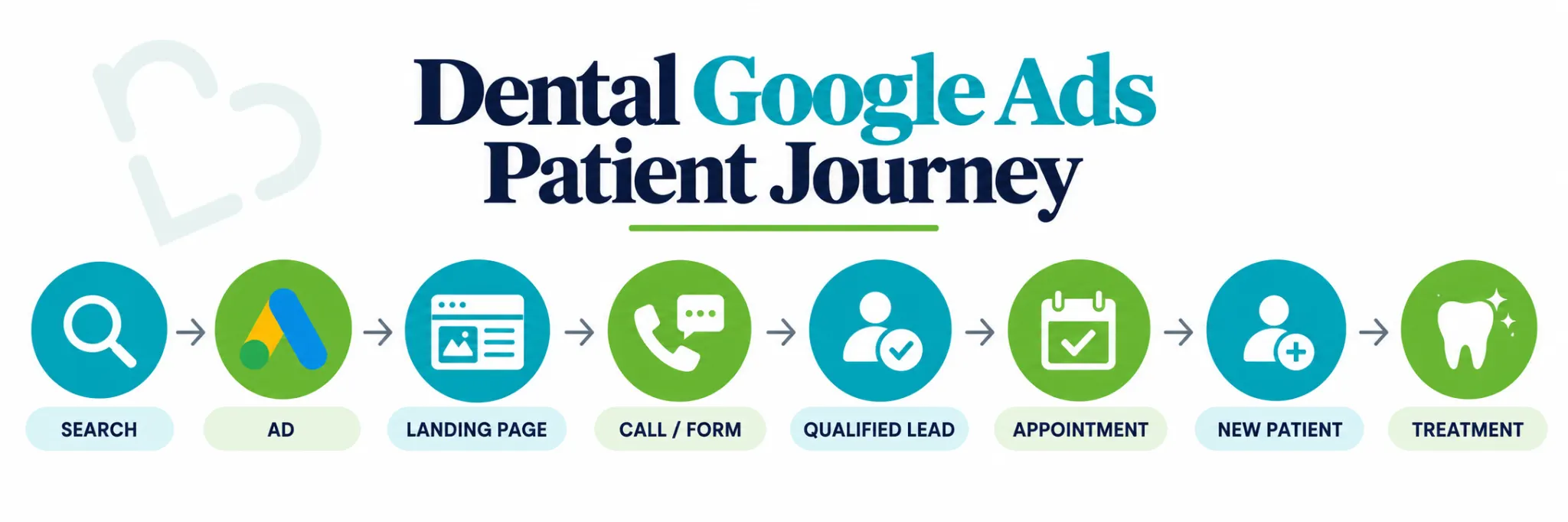
Results depend on more than the bid. Search intent, local competition, location settings, ad relevance, landing-page quality, conversion tracking, budget, and lead handling all matter.
This is why Google Ads management for dentists should not stop at the Google Ads dashboard. The practice also needs to know what happened after the lead arrived.
Which Google Ads Campaigns Are Best for Dentists?
Search Campaigns
Search campaigns are often a logical starting point because they can capture people actively searching for dental care. They also give practices a clear way to organize ads around specific services, locations, and search intent.
Performance Max and Other Campaign Types
Performance Max is a goal-based campaign type that can serve across Google inventory including Search, YouTube, Display, Discover, Gmail, and Maps. Google describes it as a way to complement keyword-based Search campaigns and reach customers across multiple Google channels.
It can be useful in the right account, but the decision should depend on tracking, data, budget, creative assets, and business goals—not automation alone.
AI Max for Search Campaigns
AI Max is not a separate campaign type. It is an optimization layer for Search campaigns with features including expanded search-term matching, text customization, and final URL expansion. Google’s current documentation also states that AI Max is selected by default when creating new Search campaigns.
For dental advertisers, the practical question is whether that automation improves qualified patient acquisition while preserving appropriate control over locations, brand terms, landing pages, and messaging.
How to Choose the Right Google Ads Keywords for Dentists
High-Intent Dental Searches
Start with intent, not volume.
A search such as “emergency dentist near me” signals a different level of urgency than “how often should I see a dentist?” Treatment and location searches often sit closer to a booking decision.
Relevant examples may include:
- Dentist + location
- Emergency dentist + location
- Dental implants + location
- Invisalign or clear aligners + location
Irrelevant or Lower-Intent Searches
Not every dental search is commercially useful. Someone looking for dental school, training, jobs, or DIY information may be irrelevant to a patient-acquisition campaign.
Negative Keywords
Negative keywords help prevent ads from showing for unwanted searches. Terms such as jobs, courses, training, school, or DIY may be useful exclusions depending on the campaign and actual search-term data.
Match Keywords to the Service
A dental implant search should generally lead to a relevant implant page, not automatically to the homepage.
This is one of the simplest principles behind a strong Google Ads strategy for dentists: keep the search, ad, and destination aligned.
How Should a Dental Practice Structure Google Ads Campaigns?
It usually makes sense to separate the bigger services, such as emergency dentistry, implants, or Invisalign, when they need their own budget, ads, or landing page. Smaller variations of the same service can usually stay together.
The main thing is to avoid overcomplicating the account. If two groups of searches need the same budget, ads, targeting, and landing page, there may be little reason to separate them. Give a service its own campaign when doing so gives you a practical reason to manage it differently.
How to Write Google Ads That Attract the Right Patients
Effective ads answer the search clearly.
A useful ad should communicate:
- The relevant dental service
- The practice location or service area
- A truthful value proposition
- Appropriate trust signals
- A clear next step
For example:
Emergency dental care in [city]. Call to ask about available appointments.
Or:
Considering dental implants? Learn about your options and request a consultation with our dental team in [city].
Avoid unsupported claims such as “best dentist,” “#1 implants,” “guaranteed results,” or “cheapest dentist.” The ad should set an expectation the landing page and practice can support.
Why Landing Pages Matter for Dental Google Ads
The ad earns the click. The landing page helps generate inquiries.
A treatment-focused landing page should include a relevant headline, useful service information, location, trust signals, reviews where appropriate, clear contact options, online booking when available, and a fast, simple mobile experience.
A person searching for dental implants should not have to hunt through a general homepage to determine whether the practice provides implants.
Strong dental website design also supports paid acquisition because the page needs to make the next step obvious without overselling.
How Much Do Google Ads Cost for Dentists?
There is no fixed Google Ads budget for every dental practice. Costs vary by location, services, competition, search demand, and how many of the leads turn into actual patients.
A practical way to work out a budget is to start with the number of new patients the practice wants.
Target New Patients × Cost Per New Patient = Ad Budget
For example, if a practice wants 20 new patients and is willing to spend $300 to acquire each one, the ad budget would be $6,000.
The $300 here is just an example, not a standard dental advertising cost. What a practice can spend will depend on things such as:
- Treatment value
- How many leads become appointments
- Available appointment slots
- Lead quality
- Competition in the local market
- Existing organic and local search traffic
It’s also important to look at what happens after someone becomes a lead. A campaign that brings in 50 leads is not necessarily performing better than one that brings in 25 if fewer of those leads become appointments or new patients.
Keep Google Ads spend and management fees separate. The ad budget is paid to Google, while management fees cover the work involved in setting up, managing, and improving the campaigns.
Dental advertising is also subject to Google’s healthcare and medicines advertising policies and applicable local regulations, which can affect what claims and offers are allowed in ad copy.
How to Measure Google Ads Success for a Dental Practice
Don’t look at clicks and leads alone. Look at what happens after someone contacts your practice.
A simple way to track the journey is:
Ad Click → Call or Form → Qualified Lead → Appointment → New Patient → Treatment
Track the numbers you can reliably measure:
- Clicks and spend: How much you’re spending and how much traffic you’re getting.
- Calls and forms: How many people are contacting the practice.
- Qualified leads: How many inquiries are from potential patients.
- Appointments: How many leads actually book.
- New patients: How many booked appointments become new patients.
- Treatment and revenue: If you can track it reliably, this shows the value coming from your ads.
A campaign that brings in 40 leads is not necessarily better than one that brings in 20. If only five of those 40 leads become patients, while 10 of the 20 do, the second campaign is producing more patients.
That’s why cost per lead and cost per new patient are two different numbers.
The more of this journey you can track, the easier it is to see what is working and where potential patients are being lost.
Not every practice can track every step perfectly. Calls, forms, booking systems, and patient records may all be in different systems. That’s okay. Track what you can and be clear about what the numbers actually represent.
Why Phone Calls and Lead Handling Matter
For many dental practices, the front desk is part of the paid-search funnel.
Track calls from ads and landing pages, identify which calls are qualified, then look at what happens afterward. Was the call answered? Was an appointment offered? Did the patient book and attend?
A campaign can generate strong leads and still underperform if calls are missed or follow-up is inconsistent.
How to Optimize Google Ads for Better Patient Acquisition
Dental PPC needs regular attention. What you need to check can change from week to week.
Each Week
Check:
- Search terms and negative keywords
- Lead quality
- Missed calls
- Any problems with conversions
Each Month
Look at:
- Cost per qualified lead
- Cost per booked appointment
- Cost per new patient
- Which services and campaigns are working
- Where the budget is going
If one campaign is bringing in lots of cheap leads but very few booked patients, don’t increase the budget right away. First check whether the problem is the targeting, search terms, ad, landing page, tracking, or lead follow-up.
Optimization should be based on what happens after the lead comes in, not just the number of conversions in Google Ads.
Common Google Ads Mistakes Dentists Should Avoid
The most common problems are practical:
- Targeting too broadly
- Sending every visitor to the homepage
- Optimizing for clicks rather than qualified leads
- Ignoring negative keywords
- Failing to track phone calls
- Mixing unrelated services without a clear strategy
- Increasing budget before fixing conversion problems
- Ignoring missed calls and follow-up
- Using unsupported claims in ad copy
More budget does not fix a broken patient journey.
When Google Ads May Not Be the Right Move
Paid search may not be the immediate priority if the practice has no capacity, regularly misses calls, lacks reliable tracking, has weak landing pages, sees little relevant demand, or cannot make the acquisition economics work.
Fixing those issues first may make future ad spend more productive.
Google Ads vs. SEO for Dentists
Google Ads and SEO solve different problems.
Google Ads can create paid visibility soon after launch, but that visibility generally continues only while the practice keeps advertising. SEO usually takes longer to build but can create longer-term organic visibility.
Both can capture active demand. The right balance depends on goals, competition, budget, timing, and existing visibility.
If you’re comparing paid search with organic growth, learn more about Dental SEO and how it can support long-term search visibility.
Neither channel is universally better.
Google Ads vs. Local Services Ads for Dentists
Google Ads Search campaigns and Local Services Ads are different products.
Search campaigns typically use search targeting and charge for interactions such as clicks. Local Services Ads use a provider profile and service-area model and generally charge for leads. Search campaigns usually charge for clicks, while Local Services Ads typically charge for leads. Availability, verification, and billing can vary by location and business type.
Check what’s available in your area before choosing between them.
A dental practice should check current eligibility in its market instead of assuming Local Services Ads are available or appropriate everywhere.
Frequently Asked Questions
Do Google Ads for dentists work?
They can. Results depend on search demand, competition, targeting, ad relevance, landing pages, tracking, budget, and how well the practice handles leads. Evaluate success by qualified inquiries, booked appointments, and new patients rather than clicks alone.
How much do Google Ads cost for dentists?
There is no universal amount. Costs vary by market, treatment, competition, demand, and campaign performance. Build the budget around the practice’s goals and patient-acquisition economics instead of relying on generic benchmarks.
What are the best Google Ads keywords for dentists?
The best keywords are the ones that match high-value patient intent for that specific practice. Treatment-plus-location and urgent-care searches may be useful, but actual search-term and conversion data should guide decisions.
How quickly can Google Ads generate dental leads?
Ads can begin appearing after a campaign is approved and starts serving, but there is no guaranteed timeline for qualified leads or new patients. Performance depends on demand, targeting, budget, competition, and conversion quality.
Should dentists send Google Ads traffic to their homepage?
Not automatically. Treatment-specific searches usually benefit from a relevant service or landing page that directly addresses the patient’s need and provides a clear next step.
How can dentists measure Google Ads ROI?
Connect ad spend to qualified leads, booked appointments, new patients, treatment starts, and revenue or patient value where reliable tracking is available. Platform conversions alone do not show the full business return.
Should a dental practice manage Google Ads in-house or hire an agency?
Either can work. In-house management may suit a practice with the time, knowledge, and tracking systems to monitor campaigns consistently. Professional Google Ads management for dentists may be more practical when the account is complex or internal time and expertise are limited.
Final Takeaway
Effective Google Ads for dentists is not just about getting your ads in front of people.
It is about reaching the right patient for the right service, sending them to the right page, tracking what happens next, and making sure the practice follows up.
If you’re reviewing your Google Ads, start by looking at where potential patients are being lost before increasing your budget.
Get Your Complimentary Google Ads & Website Assessment
Not sure what’s working in your Google Ads or where you’re losing potential patients? MediaNV can take a look at your ads, landing pages, tracking, and lead process and show you where there may be room to improve.
Get Your Complimentary Assessment →
Author: MediaNV Team
Author Bio: MediaNV specializes in digital marketing for dental practices, podiatry clinics, and MedSpas, with services including PPC, SEO, website strategy, reputation management, analytics, and patient lead systems.