
Someone considering an aesthetic treatment rarely sees one Instagram post and immediately books.
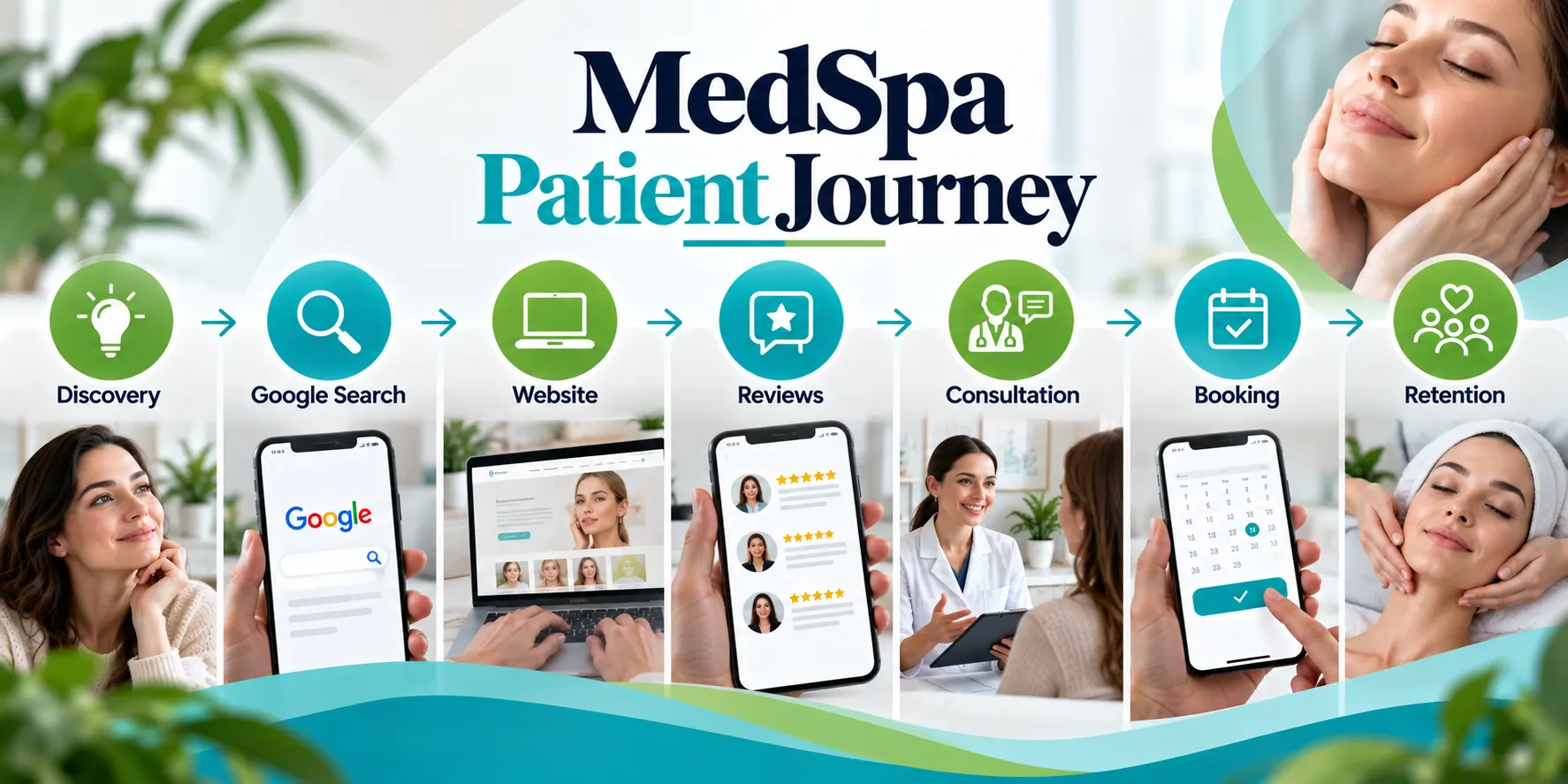
They may first discover a treatment through social media. Later, they search Google to understand what it does, compare nearby providers, read reviews, look at before-and-after photos, check credentials, visit several websites, consider pricing or financing, and finally request a consultation.
That entire sequence is medspa marketing.
The mistake is treating SEO, social media, paid ads, reviews, your website, and front-desk follow-up as separate projects. Prospective patients experience them as one journey. A polished Instagram account cannot compensate for a weak website. Strong Google rankings lose value if nobody answers inquiries. More leads do not create growth if consultations fail to become booked treatments.
The goal is not maximum traffic. It is attracting the right prospective patients, helping them make an informed decision, converting appropriate interest into consultations and bookings, and building relationships that produce repeat and referral business.
This guide explains how to build that system in 2026.
What Is MedSpa Marketing?
MedSpa marketing is the combination of strategies and systems used to attract prospective patients, increase awareness, educate them about treatments, establish trust, generate qualified inquiries, convert those inquiries into consultations and bookings, and encourage appropriate repeat visits and referrals.
That definition matters because generating attention is only the beginning.
A campaign producing 100 inquiries is not necessarily stronger than one producing 30. If the 30 leads are better matched to your services, respond to follow-up, attend consultations, and become patients, that smaller campaign may create substantially more value.
Traffic is a marketing metric. Qualified patient growth is the business goal.
Why MedSpa Marketing Is Different
A MedSpa is not selling an ordinary local service.
A prospective patient may be making an elective decision involving their face, skin, body, appearance, money, and confidence. They want more than a list of treatments. They want to know who will provide the treatment, whether the provider is qualified, what the experience will be like, what realistic outcomes look like, and whether they can trust the practice.
Visual proof also plays an unusually important role. Before-and-after content, provider videos, reviews, treatment explanations, office photography, and testimonials may all shape the decision.
Another difference is repeat potential.
Some aesthetic services involve ongoing maintenance or complementary treatments. That means strong medical spa marketing should consider both acquisition and retention. A practice that constantly pays to acquire new patients while ignoring its existing patient base may be leaving significant growth opportunities on the table.
You are not simply marketing a procedure. You are building confidence in the provider, the treatment decision, and the experience of choosing your practice.
Want to know where your MedSpa is losing potential patients?
Start With the Economics Before Choosing Marketing Channels
Before deciding whether you need SEO, Google Ads, more social content, or another campaign, understand the numbers behind your patient journey.
The basic path is:
Marketing Cost → Lead → Qualified Lead → Consultation → Booking → Revenue → Patient Lifetime Value
Without that connection, it is easy to optimize the wrong metric.
Customer Acquisition Cost
Customer acquisition cost, or CAC, tells you how much you spend to acquire an actual patient.
If you spend $4,000 on marketing and generate 40 leads, your cost per lead is $100. But suppose only eight ultimately become paying patients. Your acquisition cost is $500 per patient.
That second number is usually much more useful.
Cost Per Lead vs. Cost Per Booked Patient
Cheap leads can be expensive.
A campaign generating $30 leads sounds attractive until you learn that most inquiries are outside your service area, want a treatment you do not offer, or never respond.
Another campaign may produce $120 leads but convert far more into consultations and treatments.
Judge medspa lead generation by quality and downstream results, not lead volume alone.
Patient Lifetime Value
The first transaction is only part of the economics.
Suppose two channels each cost $400 to acquire a patient. Patients from one channel usually complete one treatment. Patients from the other return appropriately for future treatments and refer friends.
Those channels do not have equal value.
Patient lifetime value helps you think beyond the initial booking and account for repeat visits, cross-service opportunities, and referrals.
Break-Even Thinking
Use your own economics rather than industry averages.
For example, imagine a campaign costs $3,000 and produces 15 consultations. Six become booked patients and collectively generate $9,000 in initial collected revenue.
That example does not prove the campaign is profitable. You still need to consider treatment costs, staff time, discounts, overhead, repeat value, refunds, and other relevant expenses.
The point is simpler: you should be able to trace marketing dollars toward real business outcomes.
Decide Which Treatments and Patients to Prioritize
One of the most common mistakes in medical spa marketing strategies is promoting every treatment equally.
Not every service deserves the same budget, SEO investment, landing-page attention, or promotional push.
Consider each treatment based on:
- Local search demand
- Competition
- Revenue potential
- Repeat potential
- Seasonality
- Current capacity
- Strategic importance
- Consultation potential
- Reliable internal margin information
Then connect the treatment to the person most likely to consider it.
Avoid vague audience definitions such as “women aged 25–55.”
A useful profile is more specific: someone who lives within a realistic driving distance, has already researched a particular concern, understands the approximate commitment involved, has objections around downtime or cost, and is comparing two or three providers before booking.
Your priorities also change with business stage.
A new MedSpa may need to establish its core services, local visibility, reviews, and booking flow first. An established practice may need to improve conversion or expand a proven service. A mature practice may gain more from retention, reactivation, cross-service education, or improving underperforming channels than simply increasing lead volume.
There is no treatment that is universally the “best” service to market.
Build a MedSpa Website That Converts Visitors Into Patients
Visibility gets someone to your site. Conversion determines whether that visit creates an opportunity.
Homepage
Within a few seconds, visitors should understand:
- What type of practice you are
- Where you are
- Your main services
- Who provides treatment
- Why someone may choose you
- How to book
Do not make users decipher abstract brand language before they understand what the business actually does.
Treatment and Service Pages
Important services deserve useful dedicated pages.
Depending on the treatment, explain:
- What it is
- Who may consider it
- What the process involves
- Realistic expectations
- Preparation
- Recovery or aftercare
- Provider qualifications
- Common questions
- Relevant trust factors
- The next step
Do not create pages for treatments the practice does not actually provide.
Good service pages can support medspa SEO, paid campaigns, internal linking, patient education, and consultation conversion at the same time.
Conversion Elements
Make the next action obvious.
Useful conversion options may include online booking, click-to-call buttons, consultation forms, prominent contact information, provider information, reviews, location details, and financing information when applicable.
Do not overwhelm the page with ten competing calls to action.
What Patients Want to Know Before Booking a Treatment
Before booking, patients want to know what to expect. Make the answers clear and easy to find on each treatment page.
Cover the basics:
- What is the treatment?
- Who is it for?
- Who performs it?
- What happens during the appointment?
- Is there any preparation or downtime?
- When should patients expect results?
- How long can results last?
- What are the risks or limitations?
- What happens during the consultation?
- How is the treatment priced?
Clear answers help patients feel informed, set realistic expectations, and take the next step with confidence.
MedSpa SEO and Local Search
Strong medical spa SEOstarts with understanding why someone is searching, not simply finding keywords with volume.
Search Intent Before Keywords
Different searches represent different stages of the decision.
Someone searching “what does microneedling do?” is in a different position from someone searching “microneedling near me.”
Useful categories include:
- Treatment intent
- Location intent
- Concern-based searches
- Informational searches
- Commercial investigation
- Branded searches
Build content around those needs.
Treatment Searches vs. Concern Searches
Patients do not always search for a treatment by name. They may search for a concern, compare options, or look for a provider nearby.
| Search type | Example | Best content |
| Treatment | Botox Calgary | Treatment page |
| Concern | How to reduce forehead lines | Educational content |
| Comparison | Botox vs. fillers | Comparison guide |
| Local | MedSpa Calgary | Local/service page |
| Commercial | Botox consultation Calgary | Conversion page |
A strong MedSpa SEO strategy connects these different search intents to the right content, rather than creating pages around keywords alone.
Treatment-Level SEO
Important treatments need enough depth for search engines and prospective patients to understand them clearly.
A practice offering Botox, dermal fillers, microneedling, laser treatments, skin rejuvenation, or body contouring should prioritize only the services it actually provides.
A useful treatment page should answer the questions a serious prospective patient asks before booking, not simply repeat the treatment name twenty times.
MediaNV Observation
When we look at MedSpa SEO, we don’t just look at rankings. We also check whether the right treatment pages are showing up and whether they give people the information they need before contacting the practice.
Local SEO and Google Maps
Medspa local SEO matters because many treatment searches have geographic intent.
Google states that local results are primarily influenced by relevance, distance, and prominence. Complete business information, reviews, links, and accurate profile details can contribute to local visibility, but there is no legitimate way to pay Google for a better organic local ranking.
Focus on:
- Accurate Google Business Profile information
- Relevant categories and services
- Consistent location and contact information
- Genuine reviews
- Useful local content
- Local authority and relevant mentions
- Strong treatment pages
Avoid mass-producing thin city pages that differ only by location name.
Internal Linking and Topic Architecture
Internal links should show both users and search engines how information connects.
For example:
Core MedSpa page → Treatment pages → Educational content → Relevant location content → Consultation CTA
That structure is more useful than publishing isolated pages that never connect to one another.
Content Marketing That Helps Patients Make Decisions
The goal of content marketing is not “four blogs per month.”
The goal is to reduce uncertainty before someone books.
Useful topics may include:
- Treatment comparisons
- Candidacy questions
- Preparation
- Recovery expectations
- Common misconceptions
- Treatment timing
- Maintenance
- Provider perspectives
- Questions your staff repeatedly hears
- Local questions relevant to your market and patient base
A good article should answer a real question better than the treatment page can without duplicating it.
Local content can also be useful when it answers genuine questions about your market, service area, or patient journey. It should provide real value rather than repeat the same content across multiple city pages.
Whenever possible, use first-hand provider knowledge. If your injector repeatedly hears the same concern during consultations, that may be more useful content than another generic “Top Five Benefits” article.
Social Media Marketing for MedSpas
Think of medspa social media marketing as:
Discovery + Education + Trust + Proof
Instagram and other social platforms can introduce the practice, humanize providers, explain treatments, answer common questions, and help prospective patients understand what the experience may be like. Appropriate behind-the-scenes content can introduce team members, show the practice environment, or explain what happens before and after an appointment, while respecting patient privacy and consent.
Legitimate testimonials and before-and-after content can also provide useful proof when they are appropriate, permitted, and supported by the necessary patient consent.
Short-form video is particularly useful when providers can explain a treatment in plain language.
However, social media should not exist in isolation.
A realistic path may look like:
Social discovery → Google search → Website → Reviews → Consultation
That is why follower count alone is a weak measure of business performance.
Google Ads and Paid Search for MedSpas
Paid search can capture existing demand quickly.
Someone searching a specific treatment in a specific city may have substantially stronger intent than someone passively seeing an awareness post.
Effective medspa advertising should consider:
- High-intent searches
- Geographic targeting
- Branded and non-branded campaigns
- Treatment-specific landing pages
- Negative keywords
- Call and conversion tracking
- Lead quality
- Ongoing testing
Optimize toward qualified consultations and booked patients rather than clicks alone.
Healthcare and aesthetic advertisers also need to review current platform policies carefully. Google treats health as a sensitive interest category for personalized advertising, and some healthcare-related advertising is restricted or subject to additional requirements.
Campaign settings that were permitted previously should not be assumed to remain compliant indefinitely.
Lead Response and Conversion
This is where many otherwise strong marketing campaigns break.
Marketing does not end when someone submits a form.
MediaNV Observation
A lead can look good in a report and still go nowhere. We look at what happens after the enquiry, including missed calls, follow-up, and how easy it is for someone to book.
The actual funnel is:
Lead → Contact → Consultation → Booking → Attendance → Treatment
Review what happens at every stage.
How quickly are inquiries noticed?
What happens to missed calls?
Does someone attempt follow-up again?
Can staff answer common questions confidently?
How easy is consultation scheduling?
Are reminders sent?
What happens after a no-show?
If deposits are used, are they explained clearly and applied consistently?
Do staff know which inquiries came from paid campaigns?
Do not obsess over a universal response-time benchmark. The practical goal is to respond while interest is still active and build a reliable process so inquiries do not disappear.
Staff training matters here as much as ad optimization.
Get a MedSpa Marketing Assessment
Reviews and Reputation Management
A prospective patient may compare two medically qualified providers and choose between them based largely on reputation.
Build an ethical system for requesting genuine feedback at an appropriate point in the patient journey, making reviews easy to submit, monitoring new feedback, responding professionally, and learning from recurring comments.
Never use fake testimonials, purchase fabricated reviews, suppress all negative feedback, or selectively make review submission difficult for unhappy patients.
If you want to reuse a review, testimonial, patient photo, or other patient-generated content in marketing, make sure you have any consent required for that use.
Testimonials also need to represent genuine experiences. In the United States, the FTC requires endorsements and testimonials to be truthful and not misleading, and material relationships may need disclosure. Federal Trade Commission
Patient Retention, Rebooking, Reactivation and Referrals
Acquisition gets someone through the door. Experience and follow-up determine whether they come back.
Rebooking
Where clinically and operationally appropriate, make the next step clear before the patient leaves.
Do not rely on the patient remembering months later.
Reactivation
Identify patients who have not returned when expected and use appropriate, permission-based communication to reconnect.
Email and SMS
Use email and SMS for relevant reminders, education, follow-up, reactivation, or announcements where permitted.
Do not treat an existing patient database as permission to send anything you want.
Memberships
Memberships can help some MedSpas create repeat engagement or simplify ongoing care, but they are not automatically appropriate for every practice.
The economics and treatment model need to support them.
Referrals
Satisfied patients can become an important acquisition source.
The best referral strategy starts with an experience worth recommending. Formal referral programs may also be useful where legally and professionally appropriate.
Patient Experience
No marketing campaign can permanently compensate for difficult scheduling, poor communication, long delays, unclear pricing, or inconsistent care.
Retention begins with the experience itself.
How to Choose the Right MedSpa Marketing Channels
Use the business objective to decide what deserves attention first.
| Goal | Likely Priority |
| Capture immediate demand | Paid search and local search |
| Build long-term organic visibility | SEO, useful content and local authority |
| Increase brand discovery | Social media and video |
| Strengthen trust | Reviews, provider content and legitimate testimonials |
| Improve conversion | Website, booking flow and lead response |
| Increase repeat business | Rebooking, CRM and email/SMS |
| Generate more referrals | Patient experience, reputation and referral systems |
The right mix depends on your market, treatments, competition, capacity, existing visibility, and business stage.
A practice ranking well organically but converting poorly should not automatically invest in more SEO content.
A new practice with a strong website but little demand capture may benefit from search advertising.
A busy practice with weak rebooking may need operational improvements more than additional lead generation.
MedSpa Marketing Compliance: Canada vs. United States
MedSpa advertising rules can vary quite a bit depending on where a clinic operates. The requirements may depend on the province or state, the professional providing the treatment, the treatment being advertised, and the platform where the ad appears.
In Canada, the rules can come from federal requirements, provincial regulations, and professional colleges. In Alberta, for example, the College of Physicians & Surgeons of Alberta (CPSA) has advertising standards for physicians and physician assistants. These cover areas such as accuracy, evidence, testimonials, treatment claims, and how results are presented. Other professionals may have different regulatory requirements.
In the United States, the Federal Trade Commission (FTC) requires advertising claims to be truthful, not misleading, and properly supported. This matters when promoting treatment results, health claims, testimonials, or endorsements. State requirements and advertising platform policies can add another layer.
One thing we see often in marketing is the assumption that a campaign can simply be copied from one market to another. It cannot. A campaign used for a Calgary clinic may need to be handled differently for a MedSpa in California, Texas, Ontario, or another market.
Before publishing treatment claims, testimonials, before-and-after photos, or promotional offers, check the requirements that apply to the specific practice, provider, location, and platform.
This section provides general information and should not replace advice from a qualified legal or regulatory professional.
How to Measure MedSpa Marketing ROI
Measure the whole funnel rather than stopping at website traffic.
Visibility
Track measures such as impressions, organic visibility, local visibility, and branded search interest.
Traffic
Understand where visitors come from:
- Organic search
- Paid search
- Referrals
- Social platforms
Leads
Track calls, forms, consultation requests, and booking requests.
Lead Quality
Now move closer to revenue:
- Qualified leads
- Consultation rate
- Booking rate
- Attendance rate
Financial Performance
Measure:
- Cost per lead
- Cost per consultation
- Cost per booked patient
- Customer acquisition cost
- Collected revenue
- Patient lifetime value
- Return on marketing investment
This is where medspa digital marketing becomes a business system instead of a reporting dashboard.
Traffic is a marketing metric. Booked patients and revenue are business outcomes.
Common MedSpa Marketing Mistakes
The most damaging mistakes are usually strategic rather than technical.
- Marketing every treatment equally: Budget and effort become spread across services with very different economics and demand.
- Buying traffic before fixing conversion problems: More visitors simply expose the same website or booking problems to a larger audience.
- Ignoring local search: High-intent local prospects may never find the practice.
- Measuring leads instead of booked patients: High volume can disguise poor conversion and weak revenue.
- Publishing generic AI-generated content: Large volumes of interchangeable content add little value and make it harder to demonstrate genuine expertise.
MedSpa Marketing in 2026: What Has Changed?
Search is changing, but the fundamentals still matter. MedSpa websites need to provide clear, useful information that helps people make decisions.
AI Overviews and Google AI Mode Matter
Google says the same SEO fundamentals used for traditional Search also apply to AI Overviews and AI Mode. There is no special AI schema or separate optimisation trick required. Your pages still need to be useful, clear, crawlable, and eligible for Search.
Search Is Multisurface
People can discover a MedSpa through Google Search, Google Maps, AI search, images, videos, reviews, and social media. Your information should be clear and consistent across these places.
First-Hand Experience and Entity Clarity Matter
Make it easy to understand:
- Who the MedSpa is
- Where it is located
- What treatments it offers
- Who provides those treatments
- What experience and qualifications the providers have
- What makes the practice different
Useful content based on real experience is more valuable than publishing large amounts of generic content simply to target keywords.
How to Market a New MedSpa
Before opening, focus on the foundation.
Clarify positioning. Build the website. Establish the appropriate Google Business Profile presence. Prepare booking systems and tracking. Create foundational treatment content. Set up your social profiles and begin building a pre-launch audience where appropriate. Decide how leads will be handled before the first campaign launches.
After opening, prioritize local visibility, patient experience, reviews, high-intent search demand, conversion, and follow-up.
Do not launch five marketing channels simply because they appear on a checklist.
A new practice with limited resources is usually better served by executing a smaller number of priorities well and expanding once the foundation works.
A Practical 90-Day MedSpa Marketing Plan
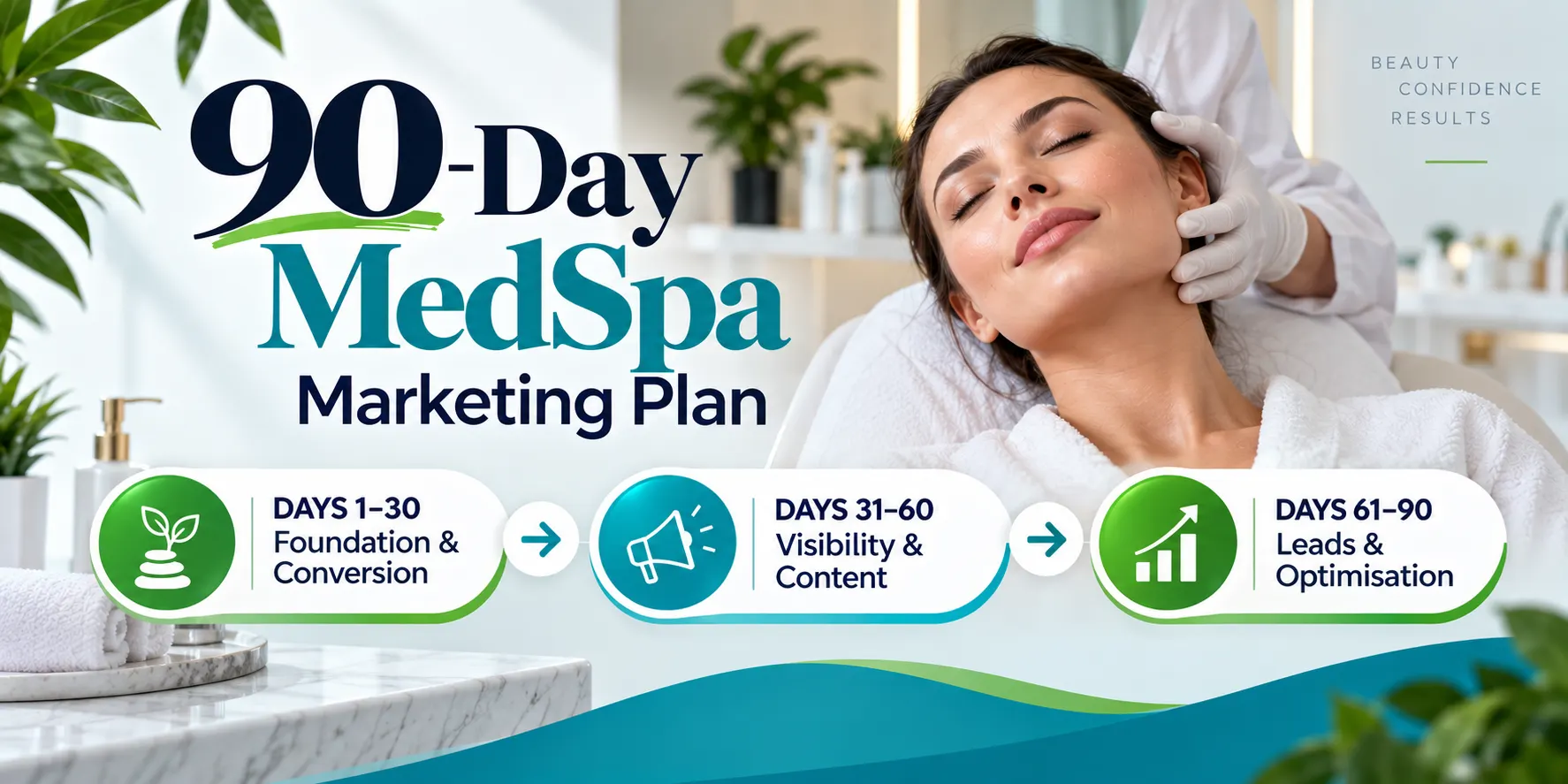
You do not need to change everything at once. A 90-day plan gives you time to fix the important things first, then see what is actually bringing in patients.
| Period | Main focus |
| Days 1–30 | Foundation and conversion |
| Days 31–60 | Visibility and content |
| Days 61–90 | Leads and optimisation |
Days 1–30: Foundation and Conversion
- Check the website, treatment pages, SEO, Google Business Profile, reviews, and tracking.
- Look at which treatments you want to promote and who you want to reach.
- Fix problems that make it harder for people to enquire or book.
Days 31–60: Visibility and Content
- Improve the main treatment pages and local SEO.
- Add content that answers the questions patients are asking.
- Keep the Google Business Profile and reviews up to date.
- Review your Google Ads and make changes where needed.
Days 61–90: Leads and Optimisation
- Look at where your leads are coming from and how many turn into bookings.
- Check missed calls, follow-up, and booking problems.
- Keep the campaigns and content that are bringing in the right enquiries.
- Stop or change things that are not working.
By the end of 90 days, you should have a much clearer picture of what is bringing in patients and what needs more work.
MedSpa Marketing Case Study: SkinSavvy Aesthetics and Laser
The Situation
SkinSavvy Aesthetics and Laser is a MedSpa in Etobicoke, Ontario. We’re working with the team to improve their Google visibility and help more local patients find the treatments they offer.
What We Worked On
We worked across the main areas that affect online visibility and enquiries:
- SEO and treatment pages
- Google Business Profile and local SEO
- Website improvements
- Content
- Lead tracking
Results
The work is already showing good progress in search. We’re still working on the account and tracking the results as we go.
What We Learned
Getting more people to the website is only part of the job. They also need to find the treatment they are looking for and have a clear way to enquire or book.
When Should You Hire a MedSpa Marketing Agency?
Professional help may make sense when growth is being limited by several connected problems rather than one isolated task.
Common signs include inconsistent lead flow, poor local visibility, weak organic performance, low website conversion, ineffective paid campaigns, poor tracking, limited internal resources, fragmented marketing, difficulty scaling, or a lack of specialist knowledge in MedSpa marketing.
A strong medspa marketing agency should help connect strategy, SEO, local search, content, website conversion, paid acquisition, tracking, reporting, and ongoing optimization.
More importantly, it should understand the economics and decision process behind aesthetic services.
MediaNV specializes in marketing for dental clinics, podiatry clinics, and MedSpas rather than positioning itself as a general agency for every healthcare category. Its MedSpa services include search marketing, website strategy, local visibility, reputation, analytics, social media, and lead-capture support.
If you are evaluating professional med spa marketing support, start with an audit of the current patient journey rather than asking which individual tactic the agency wants to sell.
Explore MediaNV’s MedSpa marketing services.
Frequently Asked Questions About MedSpa Marketing
What is the best marketing strategy for a MedSpa?
There is no single best strategy. Start with your treatment economics, target patients, website, local presence, tracking, and lead handling. Then choose channels according to the growth problem you are trying to solve.
How can a MedSpa get more patients?
If you are researching how to get more medspa patients, look beyond lead volume. Improve visibility for priority treatments, build stronger trust signals, make booking easier, respond consistently to inquiries, and create systems for retention and referrals.
Is SEO worth it for a MedSpa?
It can be when prospective patients actively search for the treatments you provide and your market has meaningful organic opportunity. Medspa SEO is usually a longer-term investment and should be evaluated alongside conversion quality and patient acquisition economics.
Is Google Ads or SEO better for a MedSpa?
They serve different purposes. Paid search can capture demand quickly, while SEO can build organic visibility over time. Many practices use both, but budget, competition, existing rankings, treatment priorities, and capacity should determine the mix.
How can a MedSpa improve its Google ranking?
Create useful treatment content, maintain accurate business information, improve technical SEO, strengthen internal linking, build genuine local authority, earn legitimate reviews, and optimize the Google Business Profile. Rankings cannot be guaranteed.
How important are reviews for MedSpa marketing?
Reviews influence trust and may contribute to local prominence. They are particularly important when prospective patients are comparing several providers offering similar treatments. Google explicitly notes that reviews and positive ratings can contribute to local ranking.
How long does MedSpa SEO take?
There is no reliable universal timeline. Results depend on the starting condition of the website, competition, market size, technical issues, content quality, local authority, and the search terms being targeted. Evaluate progress over time rather than expecting a fixed deadline.
How much should a MedSpa spend on marketing?
Do not start with an arbitrary percentage. Work backward from capacity, treatment economics, acceptable customer acquisition cost, growth goals, and the channels available in your market. A practice unable to handle additional consultations should fix capacity or conversion before aggressively increasing acquisition spend.
Build a MedSpa Marketing System, Not a Collection of Tactics
Strong medspa marketing is not about doing everything.
It is about doing the right things in the right order.
Understand the economics first. Build the foundation. Create visibility where qualified prospective patients are actually looking. Establish trust. Remove friction from booking. Follow up consistently. Deliver an experience worth returning to. Then measure what reaches consultations, treatments, retention, referrals, and revenue.
That system also gives you a better answer when a new platform, trend, or marketing idea appears.
Instead of asking, “Should we do this too?” you can ask:
Where does this fit in our patient journey, what problem does it solve, and how will we know whether it worked?
That is a much stronger way to approach medical spa digital marketing in 2026.
If your MedSpa has strong clinical care but inconsistent visibility, lead flow, conversion, or tracking, MediaNV can help you identify where the system is breaking down and which opportunities deserve attention first.
Start with a practical review of your current marketing, patient journey, and growth priorities rather than another disconnected campaign.
Find the Biggest Gaps in Your MedSpa Marketing
Author: MediaNV Team
Author Bio: MediaNV specializes in digital marketing for dental practices, podiatry clinics, and MedSpas, with services spanning SEO, paid acquisition, website strategy, local search, reputation management, analytics, social media, and patient lead systems.