
A patient looking for a dentist rarely makes a decision from a single search result. They may search for a service, compare nearby practices, check Google Maps, visit several websites, read reviews, look at provider information, and then decide which office to contact.
That journey can look like this:
Search → Compare → Check Maps → Visit Website → Read Reviews → Contact → Book
Dental SEO supports that journey by helping a practice become easier to find, understand, and evaluate across search engines and local search platforms. It connects website content, technical performance, local visibility, reputation, authority, and increasingly AI-powered search experiences.
The goal is not simply to rank for more keywords. A strong SEO strategy should help the practice appear for relevant searches and turn that visibility into qualified patient opportunities.
What Is Dental SEO?
Dental SEO is the process of improving a dental practice’s website and online presence so search engines can better understand what the practice offers, where it operates, and which patient searches it is relevant for.
Dental search is different from many other industries because patients usually have both a service need and a local need. Someone may search for a “dentist near me,” while another person may be looking specifically for dental implants, Invisalign, an emergency dentist, pediatric dentistry, or a root canal in their area.
That makes dental SEO both service-focused and location-focused. Depending on the practice and its goals, it may involve:
- Optimizing a Google Business Profile
- Creating useful service and location pages
- Improving website structure and technical performance
- Researching how patients search for dental care
- Publishing helpful educational content
- Building legitimate authority and relevant backlinks
- Managing local information and reviews
- Making the practice, its services, locations, and dentists easier to understand across search
Dental SEO also differs from paid advertising. SEO focuses on earning visibility in organic search results and local search over time, while Google Ads provides paid placement while campaigns are running. Both can contribute to patient acquisition, but they work in different ways.
Search is also becoming more answer-oriented, with Google AI Overviews and other AI-powered search experiences increasingly answering questions directly. The practical takeaway is not to create a separate “AI SEO” system, but to make the practice’s information clear, useful, trustworthy, well-structured, and supported by genuine expertise.
Why Is Dental SEO Important for Dentists?
Patients often begin searching for dental care before they know which practice they will choose.
They may look for a general dentist in their city, search for a specific service, compare Google Maps listings, research treatment options, read reviews, and visit practice websites before contacting anyone.
Effective dentist SEO helps the practice become visible during these different moments.
Local visibility is especially important because dentistry is usually location-dependent. A practice may have excellent providers and services but still lose opportunities if competing offices are easier to find in Search and Maps.
Searchers may also consider:
- Whether the practice provides the service they need
- How close the office is
- Who the dentists are
- What other patients say
- Whether the website feels current and trustworthy
- How easy it is to call or request an appointment
SEO therefore extends beyond rankings. It affects how clearly search engines understand the practice and how easily prospective patients can evaluate it.
The meaningful outcome is not simply more traffic. It is greater visibility for relevant searches that can lead to qualified calls, appointment requests, and new-patient opportunities.
The Core Components of Dental SEO
Strong dental SEO works as a connected system. Improving one area while ignoring the others can limit the overall result.
The sections below explain how these pieces work together in a dental setting.
Dental SEO Priorities: What Should a Practice Focus on First?
Not every dental practice needs to tackle every SEO task at the same time. The right starting point depends on the practice’s website, local visibility, competition, services, number of locations, and current search performance.
A practical starting framework is:
| Priority | SEO area | What to address first |
|---|---|---|
| 1 | Technical foundation | Indexing, crawlability, mobile usability, redirects, page performance, and major technical issues |
| 2 | Google Business Profile and local SEO | Accurate business information, categories, services, reviews, photos, and local relevance |
| 3 | Service pages | Create or improve dedicated pages for the treatments the practice actually provides |
| 4 | Website architecture and internal linking | Connect services, locations, providers, and educational resources logically |
| 5 | Search intent and content | Build useful content around patient questions, treatment research, and commercially relevant searches |
| 6 | Reputation and authority | Earn genuine reviews, relevant mentions, relationships, and authoritative links |
| 7 | Conversion measurement | Connect organic visibility with calls, forms, appointment requests, and booked patients where tracking allows |
This is a starting framework, not a fixed checklist. Priorities can change when a practice has a specific constraint. For example, a website with important pages blocked from indexing should address that before publishing more content. A practice with strong organic rankings but weak local visibility may benefit more from improving its local presence. A practice with good visibility but poor appointment conversion may need to focus on what happens after the search, rather than simply creating more pages.
What we’ve seen across Canadian and U.S. dental campaigns: the biggest SEO gains rarely come from one change alone. The strongest results usually come from improving the right combination of technical SEO, service pages, local visibility, internal linking, content, and authority. We then adjust those priorities based on each practice’s search performance, competition, and growth opportunities.
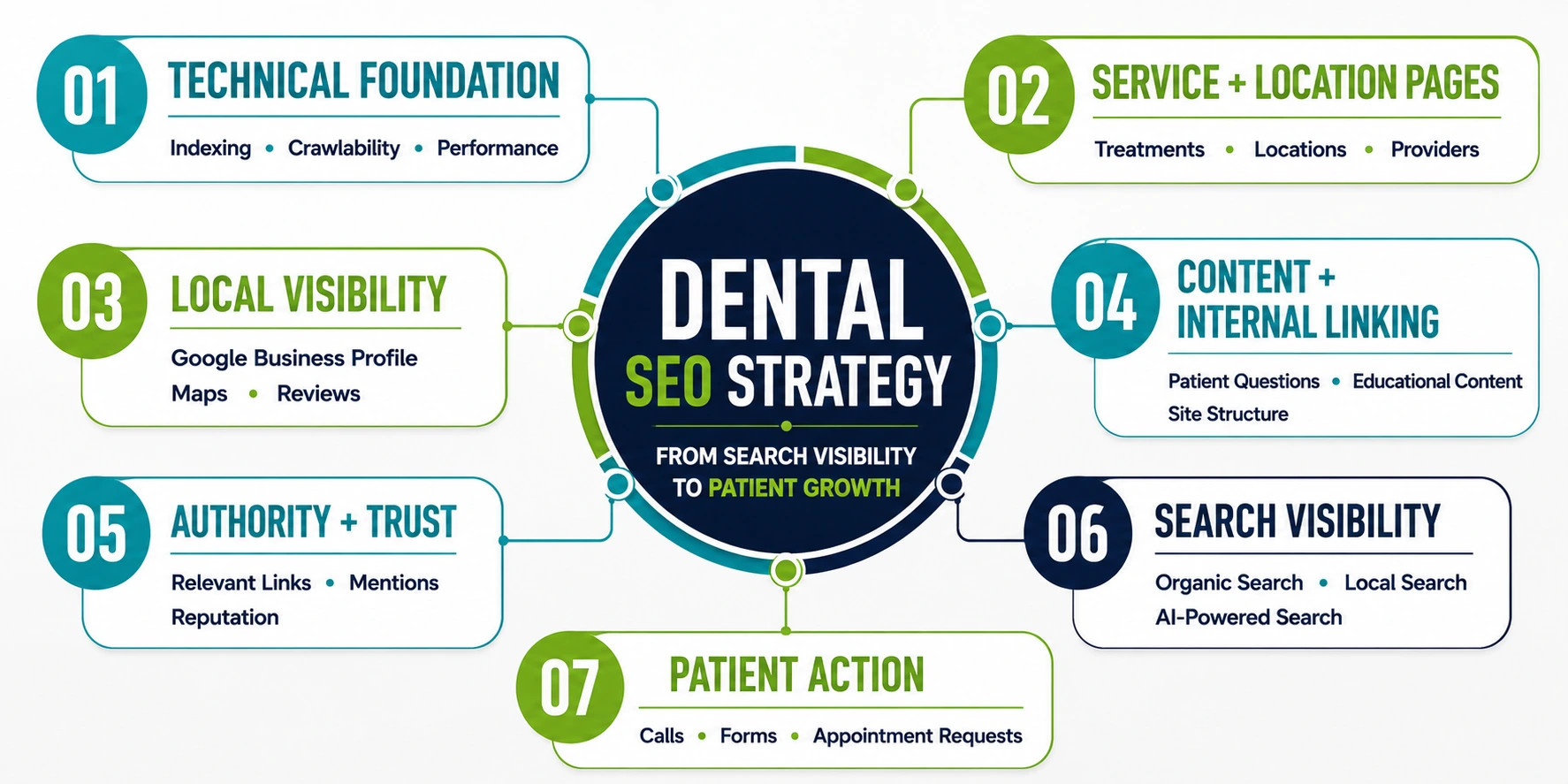
AI-powered search does not need to be treated as a separate final step. The same fundamentals that help search engines understand a dental practice, including clear service information, useful content, strong internal linking, local relevance, trustworthy sources, and genuine expertise, can also help provide useful information for AI-powered search experiences.
The important principle is to fix the highest-impact constraint first rather than completing SEO tasks in an arbitrary checklist order.
Local SEO for Dental Practices
For most dental offices, local SEO for dentists should be a major part of the overall strategy because patients usually need care within a practical travel distance.
Google describes relevance, distance, and prominence as core factors in local search. That means local visibility is influenced by more than a business listing alone. Accurate business information, website relevance, reviews, links, and geographic context all matter.
A strong local strategy begins with an accurate Google Business Profile for dentists. The profile should reflect the real practice rather than being treated as a place to insert as many keywords as possible.
Start with the basics: Make sure your Google Business Profile accurately represents the practice, including its name, location, contact information, hours, categories, services, and other relevant details. The information should be consistent with the practice website and other important local listings. For more detail, see MediaNV’s Local SEO for Dentists: What Every Practice Should Know.
The website and profile should reinforce each other. If the profile says the practice provides dental implants, for example, the website should contain useful information about that service. Provider, address, service, and contact information should also be consistent.
This connection matters for Google Maps SEO for dentists because Maps visibility is not created by the Business Profile alone. Search engines can also use information from the practice website, reviews, links, directories, and other public sources when understanding a local business.
NAP — name, address, and phone number — should remain consistent across important directories and local references. Citations still have a role, but creating hundreds of low-value listings should not become the center of the strategy. Accuracy, local relevance, website quality, reputation, and authority deserve more attention than raw citation volume.
Reviews also support trust and local reputation. Practices can make it easy for genuine patients to provide honest feedback, monitor new reviews, and respond professionally. Responses should avoid discussing treatment details or unnecessarily confirming private information.
The website should support local intent through useful service and location content. A single-location practice usually does not need dozens of nearly identical city pages. Multi-location practices may need individual location pages, but each should contain genuine information about that office.
Local authority can also grow through meaningful community relationships, professional organizations, local media coverage, sponsorships, or other legitimate connections that result in relevant mentions or links.
Dental Website SEO: On-Page + Technical SEO
A dental website has to work for two audiences at once: prospective patients and search engines.
Good dental website SEO helps search engines understand what each page represents while making the site easy for patients to navigate and use.
On-Page SEO
Every important page should have a clear purpose. A dental implant page, for example, should primarily address dental implants rather than trying to rank for every cosmetic and restorative service the practice offers.
Useful on-page elements include:
- Title tags: Clearly describe the page topic and, where appropriate, location.
- H1 and H2 headings: Organize the page logically and make important topics easy to identify.
- Search intent: Make sure the content actually answers what the searcher is looking for.
- Internal links: Connect related services, educational resources, providers, and locations.
- Images: Use useful visuals with appropriate filenames, dimensions, and alternative text.
- Meta information: Write titles and descriptions that accurately represent the page.
- Service content: Explain what the practice provides without creating thin or repetitive pages.
Internal linking is particularly useful on larger dental websites. A blog about implant aftercare, for example, may naturally link to the dental implant service page, while that service page might link to the dentist’s bio or relevant financing information.
Technical SEO
Technical SEO for dentists focuses on whether search engines can reliably access, interpret, and index the website.
Important areas include:
- Crawlability
- Indexability
- Mobile usability
- HTTPS
- XML sitemaps
- Canonical URLs
- Broken links and redirects
- Page performance
- Structured data
A technically polished site will not compensate for weak content, but technical problems can prevent strong content from performing properly.
Core Web Vitals provide practical measures of page experience. Largest Contentful Paint (LCP) reflects loading performance, Interaction to Next Paint (INP) reflects responsiveness, and Cumulative Layout Shift (CLS) reflects visual stability. These metrics help identify whether a page loads promptly, responds smoothly, and remains visually stable while users interact with it.
Structured data can also help search engines interpret information when the markup accurately reflects visible content. Structured data may be useful for relevant Organization, LocalBusiness, Person, Breadcrumb, or other supported types, depending on the page and the information being marked up.
Schema should clarify what exists on the site. It should not be used to mark up claims or information patients cannot actually see.
Dental Keyword Research and Content Strategy
Good dental keyword research starts with understanding what the searcher wants, not simply choosing the phrase with the highest search volume.
Consider these searches:
- “dentist” – broad and ambiguous
- “dentist in Calgary” – clearly local
- “emergency dentist Calgary” – local with stronger urgency
- “how much do dental implants cost” – informational or commercial research
These searches should not all lead to the same page.
Search intent helps determine what type of content should exist and what information belongs on it. Service-related searches may require comprehensive service pages. Local searches may need location context. Educational questions may be better suited to articles, FAQs, or supporting resources.
A useful dental content strategy normally includes several types of searches:
Service keywords: Dental implants, Invisalign, dentures, root canal treatment, or other services genuinely offered by the practice.
Location keywords: Phrases that connect a service or practice with a real geographic market.
Informational searches: Questions patients research while trying to understand a topic.
Commercial searches: Queries from people comparing services, providers, costs, or treatment options.
Long-tail searches: More specific questions that may have lower individual search volume but clearer intent.
The goal is not to create one page for every keyword variation. Closely related searches should usually be handled by a strong page that covers the topic naturally.
Topic clusters can help organize this information. A dental implant service page might be supported by articles about candidacy, costs, recovery questions, or comparisons with other tooth-replacement options. Internal links then connect those resources.
Search intent matters more than keyword volume because the highest-volume query is not necessarily the one most likely to produce a relevant patient opportunity.
Content should also be updated rather than endlessly duplicated. If two articles answer essentially the same question, strengthening one useful resource may be better than competing with yourself.
Dental Link Building, Reviews and Online Authority
Dental link building should focus on earning relevant, credible connections rather than collecting as many backlinks as possible.
Useful links may come from:
- Dental or professional associations
- Local organizations
- Community relationships
- Educational partnerships
- Local media
- Reputable directories
- Digital PR
- Organizations genuinely connected with the practice
A backlink is more meaningful when there is a legitimate reason for one website to reference another.
Practices should avoid purchased spam links, private blog networks, automated link schemes, irrelevant mass directory submissions, and other tactics designed mainly to manipulate rankings.
Reviews are another part of online authority. Dental reputation management should help a practice maintain an accurate picture of real patient experiences, not manufacture a perfect reputation.
An ethical process may include asking genuine patients for honest feedback, making review links easy to access, monitoring new feedback, and responding appropriately.
Public responses require particular care in healthcare. A response should not reveal treatment details or unnecessarily confirm information about the reviewer’s relationship with the practice.
Authority develops from multiple signals working together: useful content, credible providers, genuine reviews, relevant links, local relationships, accurate business information, and a website that clearly demonstrates who the practice is and what it does.
Dental SEO and AI Search in 2026
Search is becoming less dependent on a traditional list of blue links.
Google AI Overviews, Google AI Mode, ChatGPT, Gemini, Perplexity, and other AI-powered tools can help users research businesses, compare options, and ask follow-up questions conversationally.
That affects AI SEO for dentists, but it does not mean dental practices need to abandon traditional SEO. Google’s current guidance says established SEO best practices remain relevant to AI Overviews and AI Mode, and there are no separate technical requirements or special schema needed simply to appear in those experiences.
These terms describe approaches to improving how information is presented and understood, not separate Google ranking systems.
Answer Engine Optimization focuses on making information easy to understand and answer. Generative Engine Optimization generally refers to improving how information may be understood and surfaced in generative search experiences. Neither should be treated as a secret ranking system or a guarantee of citations.
The practical work is straightforward:
- Write direct answers to important patient questions.
- Use descriptive headings.
- Clearly identify the practice, providers, services, and locations.
- Maintain accurate business information.
- Connect related pages through internal links.
- Use structured data accurately where appropriate.
- Provide original and useful information.
- Show genuine experience and expertise.
- Support important claims with trustworthy sources.
- Build a legitimate reputation and authority.
Dental entity SEO is about making relationships clear. Search and AI systems should be able to understand that a specific dentist works at a particular practice, at a particular location, and provides specific services.
Dental semantic SEO extends beyond repeating exact keywords. It builds context around services, conditions, providers, locations, patient questions, and related concepts.
No SEO strategy can guarantee that a dental practice will appear in an AI Overview, ChatGPT answer, Gemini response, or Perplexity citation. Strong technical foundations, useful content, clear entities, authority, and trustworthy information simply give these systems better material to understand.
Dental SEO for Multi-Location Practices and DSOs
SEO becomes more complex when a dental group has multiple locations.
Each legitimate office should have a useful location page containing information specific to that practice, such as:
- Address and contact information
- Providers
- Services available at that office
- Appointment options
- Office-specific images
- Useful local context
Eligible locations should also maintain their own accurate Google Business Profiles where appropriate.
A common mistake is creating dozens of pages from one template and replacing only the city name. This produces little additional value and makes it harder to establish meaningful local relevance.
Multi-location SEO for dental practices should also account for location-specific services. One office may offer a service that another does not, and the website should make those differences clear.
Internal linking can help users move between the main brand, individual locations, providers, and relevant service pages without creating a confusing hierarchy.
DSOs and larger groups should also measure visibility by location. A strong overall domain can hide the fact that individual offices perform very differently in their respective markets.
How Long Does Dental SEO Take?
There is no fixed timeline for dental SEO.
Some improvements may appear relatively quickly after fixing a serious technical issue or correcting inaccurate local information. Competitive organic growth, however, usually requires sustained work.
Timelines depend on factors such as:
- Competition
- Market size
- Geographic location
- Current website condition
- Existing search visibility
- Domain and local authority
- Content quality
- Technical problems
- Competitor strength
- Frequency and quality of ongoing optimization
A new website entering a competitive metropolitan market starts from a different position than an established practice with years of local recognition and useful content.
Avoid promises such as “you will rank in three months” or “SEO always takes six months.” Search performance does not follow a universal schedule.
A better approach is to establish baseline measurements, identify the highest-priority problems, make improvements in stages, and monitor whether visibility and qualified patient opportunities improve over time.
How Much Does Dental SEO Cost?
The cost of dental SEO services varies because the amount of work required varies.
Pricing can depend on:
- Market competition
- Number of practice locations
- Current website quality
- Technical condition
- Content requirements
- Local SEO scope
- Authority and backlink needs
- Existing search visibility
- Reporting requirements
- Ongoing optimization
A single-location practice with a technically healthy website may need a much smaller scope than a multi-location group with outdated websites, duplicate content, weak local profiles, and significant technical problems.
There is therefore no universal “correct” SEO budget for every dentist.
Rather than choosing a package based only on the number of keywords or blog posts included, practices should understand what problems need to be solved and how the proposed work connects to their goals.
How to Measure Dental SEO Success
SEO reporting should move from visibility metrics toward business outcomes.
Useful search metrics include:
- Organic clicks
- Impressions
- Search visibility
- Non-branded organic traffic
- Rankings for relevant searches
Local metrics may include:
- Google Business Profile interactions
- Local visibility
- Calls
- Website clicks
- Direction requests
Business metrics matter even more:
- Qualified calls
- Form submissions
- Appointment requests
- Booked appointments where tracking allows
- Organic conversion rate
- Lead quality
Google Search Console can help measure how a website appears and performs in Search, while analytics and call or conversion tracking can show what users do afterward.
MediaNV emphasizes appointment-level measurement rather than relying only on clicks or calls, which is why SEO reporting should eventually connect visibility to genuine practice outcomes.
Traffic is useful information. It is not the final goal.
Dental SEO vs. Google Ads
SEO and Google Ads solve different problems and can complement each other.
SEO is useful for building sustained visibility around services, locations, educational topics, and practice entities.
Google Ads can help a practice compete for selected searches while SEO work develops or when the practice wants additional visibility for specific services.
The right balance depends on competition, budget, patient-acquisition goals, and existing organic visibility.
MediaNV’s Pay-Per-Click Marketing page provides more information about how paid search can complement other channels.
Should You Do Dental SEO Yourself or Hire an Agency?
Some dental practices can manage basic SEO internally.
DIY may make sense when the practice has:
- One location
- A relatively simple website
- Lower local competition
- Someone with enough time to maintain SEO consistently
- Basic technical and local SEO knowledge
Professional support may become more useful when the practice faces:
- Strong competition
- Multiple locations
- Significant technical problems
- Large content requirements
- Advanced local SEO needs
- Complex analytics or tracking
- An integrated SEO and AI-search strategy
The key question is not simply whether SEO can be done internally. It is whether someone has the expertise and time to do the necessary work consistently and measure the result.
When evaluating an agency, ask how priorities are chosen, what will actually be changed, how success is measured, and how SEO connects to qualified patient opportunities.
Real Dental SEO Experience: What We Have Seen in Practice
Real dental SEO performance usually comes from several parts of the strategy working together rather than one isolated optimization.
One verified example is Centre & 12th Dental in Calgary. MediaNV’s SEO work included Calgary-focused on-page optimization, service-page restructuring, internal linking, Google Business Profile optimization, consistent business information, local citations, and relevant backlinks.
According to the supplied case study, “Dentist Calgary” improved from outside the top 10 to position 5, while “Dentist near me” improved from outside the top 10 to position 2. The case study also reports 9,960 organic clicks and 1.36 million impressions.
Google Ads ran alongside SEO to capture high-intent searches while organic visibility developed. The campaign illustrates why dental SEO is rarely about one isolated optimization. The work combined local, on-page, technical, internal-linking, and authority improvements rather than relying on keyword additions alone.
These results are specific to Centre & 12th Dental and should not be treated as expected or guaranteed outcomes for other practices.
Dental SEO Checklist
Use this checklist to identify gaps in the practice’s current SEO foundation.
Website
- Clear service architecture
- Mobile-friendly experience
- Important pages are indexable
- Strong internal linking
- Good page performance
Local SEO
- Optimized Google Business Profile
- Accurate business information
- Useful local service and location pages
- Consistent NAP information
- Ethical review strategy
Content
- Search-intent research
- Helpful service content
- Supporting educational content
- Logical internal linking
Authority
- Relevant backlinks
- Local mentions
- Genuine reviews
Frequently Asked Questions About Dental SEO
Why is SEO important for dentists?
SEO can help prospective patients discover a dental practice while researching providers, services, and local options. It also helps search engines understand the practice’s services, providers, location, and expertise.
How much does Dental SEO cost?
Costs vary according to the practice’s market, number of locations, website condition, content requirements, technical needs, and competition. The appropriate scope should be based on the problems that need to be solved rather than a universal package.
Is Dental SEO worth it?
SEO can be valuable when prospective patients actively search online for the services a practice provides. Its value should be evaluated through relevant visibility, qualified inquiries, appointment opportunities, and long-term organic performance rather than rankings alone.
Can Dental SEO help attract more patients?
SEO for dentists can increase opportunities for prospective patients to discover and evaluate a practice. Whether those searches become patients also depends on website experience, reputation, availability, appointment processes, and follow-up.
How can dentists improve visibility in AI search?
Focus on strong SEO fundamentals: useful content, clear answers, accurate business and provider information, logical entity relationships, technical accessibility, trustworthy sources, authority, and structured information. No tactic can guarantee inclusion in AI-generated answers.
Build a Stronger Dental SEO Foundation
Strong dental SEO connects local visibility, useful content, technical performance, website structure, authority, reputation, and clear practice information. It helps prospective patients find the practice at different stages of their search while creating a foundation that can support both traditional and AI-powered discovery.
Not sure where your dental practice is losing search visibility? MediaNV can review your website, local presence, and current SEO performance to identify the highest-priority opportunities. A focused audit can clarify what needs attention first and where the existing foundation may already be working well.
Let's Grow Your Practice
Every practice has a different story. Let's talk about your goals and explore the best path to attract more patients and grow with confidence.