

A podiatry practice can have excellent providers, a strong reputation, and valuable services, yet still struggle to reach patients who are actively looking for care. Today, patients may discover a podiatrist through Google Search, Google Maps, reviews, paid ads, social media, a practice website, referrals, or an AI-powered search tool.
That is why effective podiatry marketing is not about choosing one tactic. It is about building a connected system that helps the right patients discover the practice, understand its services, evaluate their options, and take the next step.
This guide explains how that system works, which marketing channels deserve priority, how to measure patient acquisition, and how search behaviour is changing in 2026.
What Is Podiatry Marketing?
Podiatry marketing is the process of promoting a podiatry practice so prospective patients can find it, understand its services, develop trust, and contact the practice when they need foot or ankle care.
Unlike broad healthcare marketing, marketing for podiatrists needs to account for local search behaviour, condition- and treatment-specific searches, referral patterns, patient urgency, practice location, provider expertise, and the types of cases the practice wants to attract.
A complete strategy may combine SEO, Google Business Profile, paid search, content, website optimization, reviews, email, and social media with traditional activities such as professional referrals, community involvement, or local partnerships.
A general podiatry clinic may want a broad mix of patients, while another may focus more heavily on sports injuries, diabetic foot care, heel pain, orthotics, surgical cases, or another part of its service mix. A multi-location group may have different priorities in each market.
Good podiatry practice marketing starts with those business goals. More website traffic is not automatically a success if it does not produce relevant inquiries or appointments.
Positioning matters too. Patients should be able to understand what makes the practice different, whether that is its providers, accessibility, technology, range of services, locations, patient experience, or another genuine strength.
What Should a Podiatry Practice Prioritize First?
Every practice is different, but most single-location podiatry practices should start with the marketing channels closest to patients who are already looking for care.
- Start with local visibility.
Make sure your Google Business Profile, location, services, and contact information are accurate and easy to find. - Build around what patients actually search for.
Create useful pages for the conditions and services you want to be known for, such as heel pain, plantar fasciitis, bunions, diabetic foot care, sports injuries, or orthotics. - Make the next step easy.
Patients should quickly see what you treat, who provides care, where you are, and how to book an appointment. - Turn real patient experiences into trust.
Ask genuine patients for reviews and make reputation management part of the ongoing marketing process. - Track appointments, not just traffic.
Know which channels generate calls, inquiries, qualified leads, and booked appointments. Track the channels that generate qualified patient opportunities. - Use Google Ads when you need more immediate demand.
Paid search can be effective for high-intent services when the targeting, landing pages, tracking, and follow-up are handled properly.
Once these basics are working, expand into content, social media, referrals, and other channels where they make sense for the practice.
The goal is not to do more marketing. It is to focus on what is most likely to bring in the right patients.
How Patients Search for Podiatry Care
Most patients do not start by searching for a podiatrist. They usually start with a problem they want to understand or fix.
Someone with heel pain, for example, might search:
- why does my heel hurt when I walk
- plantar fasciitis treatment
- podiatrist for heel pain
- podiatrist near me
- book a podiatrist appointment
The search often becomes more specific as the patient moves from looking for answers to looking for care.
That matters when planning a podiatry website. Instead of putting everything on one general services page, give important conditions and services their own useful pages when they are relevant to the practice.
Meet patients where they are searching, answer what they need to know, and make it easy for them to contact the practice.
Why Marketing Matters for a Podiatry Practice
Patients can compare healthcare providers in more ways than ever. Someone experiencing heel pain may search for the condition, compare nearby practices on Google Maps, read reviews, visit websites, and call the office that appears most relevant and easiest to contact.
Strong podiatrist marketing helps a practice appear when prospective patients are actively searching while giving them enough information to decide whether the practice fits their needs.
Local competition makes this especially important. Two nearby practices may provide similar services, but one may have a complete Google Business Profile, useful service pages, strong reviews, clear provider information, and easy appointment options while the other has limited online visibility.
Visibility, however, is only the beginning. Marketing should connect to meaningful outcomes such as:
- Relevant phone calls and appointment requests
- Qualified new-patient inquiries
- Booked appointments
- Growth in priority services
- Patient retention and referrals
- Sustainable practice growth
The goal is to turn visibility into meaningful patient opportunities.
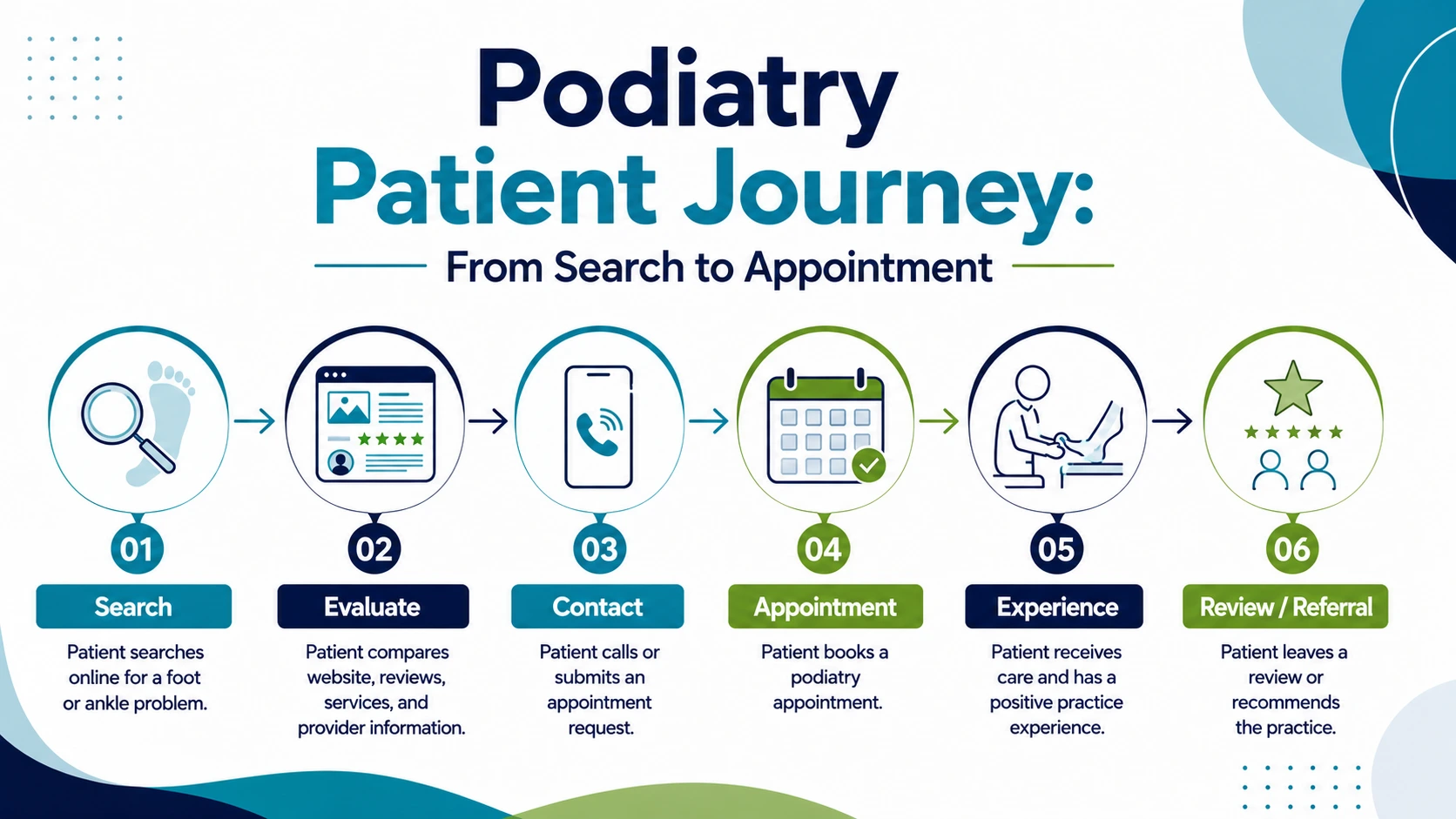
Understanding the Podiatry Patient Journey
A useful way to think about podiatry patient acquisition is:
Discovery → Evaluation → Contact → Appointment → Experience → Review/Referral
Each stage involves different marketing elements.
Discovery: A prospective patient finds the practice through Search, Maps, an ad, social media, a referral, a directory, or an AI-powered tool.
Evaluation: They compare services, providers, location, reviews, website quality, availability, and other trust signals.
Contact: They call, submit a form, or use an online booking option.
Appointment: The front desk responds, answers questions, and helps the person book.
Experience: The patient experience determines whether the marketing promise matches the practice experience.
Review or Referral: A satisfied patient may leave a review, recommend the practice, or return for future care.
This is why podiatry digital marketing should not be managed as unrelated channels. SEO can generate discovery, reviews influence evaluation, the website supports conversion, and front-desk follow-up can determine whether an inquiry becomes an appointment.
Local SEO and Google Business Profile for Podiatrists
For many podiatry practices, local visibility should be one of the highest marketing priorities.
Local SEO for podiatrists helps a practice become more visible when someone searches for a podiatrist or related service in a specific geographic area. That visibility can include organic results, Google Maps, local search results, location pages, directories, and AI-assisted discovery.
A strong Google Business Profile for podiatrists should begin with accurate fundamentals:
- Use the practice’s real business name.
- Confirm the address, phone number, website, and regular hours.
- Keep holiday and temporary hours updated.
- Select the most accurate primary and additional categories.
- Add services the practice genuinely provides.
- Write a useful business description rather than stuffing it with keywords.
- Add current photos of the practice, team, exterior, and other helpful areas.
- Include an appointment link when available.
- Monitor and respond appropriately to reviews.
The practice name, address, and phone number, often called NAP information, should also remain consistent across the website and reputable directories. Local citations can reinforce this information, but accuracy matters more than appearing in every directory available.
Local search intent should shape the pages behind the profile as well. Someone searching for a podiatrist nearby, for example, needs clear location, service, provider, and contact information rather than a generic educational page.
The website should support the profile. If a practice wants visibility for heel pain treatment, diabetic foot care, orthotics, or another service, it should have a relevant page that clearly explains that service.
Practices serving surrounding communities can also create useful service-area content when there is a genuine reason to do so. These pages should reflect real local relevance and patient needs rather than repeating the same copy with a different city name.
For practices with more than one office, each legitimate location should have useful, location-specific information. Practices should also monitor profile interactions such as calls, website clicks, views, searches, and direction requests where available.
Podiatry Website and Conversion Essentials
A website supports both search visibility and patient conversion. Effective podiatry website design should make it easy for visitors to understand the practice and take the next step.
Start with the mobile experience. A patient searching on a phone should be able to identify the practice, understand its services, find the location, call, and request an appointment without unnecessary searching.
Navigation should reflect how patients think. Important services, provider information, locations, contact details, and appointment options should be easy to find.
A strong podiatry website usually includes:
- Clear service pages
- Accurate provider information
- Location pages where appropriate
- Easy-to-find contact information
- Visible phone and appointment options
- Reviews or other appropriate trust signals
- Mobile-friendly design
- Accessible content and navigation
- Fast-loading pages
- Clear calls to action
Conversion-focused design does not mean filling every screen with “BOOK NOW” buttons. It means removing unnecessary friction.
What We Often See on Podiatry Websites
When we review podiatry websites, we often find a few simple things that could make the patient experience better.
Some practices use stock photos that do not really fit the service. Others use graphic photos of wounds, blood, or injuries that may put patients off.
We also see websites that do not explain what happens during treatment or what to do after it. Simple treatment and aftercare information can answer these questions and make patients feel more comfortable about booking.
Do I Need a New Website, or Can I Improve My Existing Website?
Not every practice needs a complete rebuild.
If the website is technically sound, mobile-friendly, reasonably fast, easy to edit, and has a workable structure, improving service pages, navigation, calls to action, local content, and technical SEO may be enough.
A rebuild becomes more reasonable when the platform creates ongoing limitations such as poor mobile usability, severe speed problems, difficult navigation, an outdated structure, weak conversion paths, or costly technical issues.
Content Marketing for Podiatry Practices
Podiatry content marketing should answer the questions real patients ask before they contact a practice.
Service pages explain what the practice provides and help prospective patients understand whether a service may be relevant. Blog content usually addresses broader questions, comparisons, concerns, or research topics.
A podiatry website might have core service pages around:
- Heel pain
- Plantar fasciitis
- Bunions
- Ingrown toenails
- Diabetic foot care
- Orthotics
- Sports injuries
Supporting articles can answer related patient questions without repeating the service page. Together, these pages form a content cluster, with internal links helping readers and search systems understand how the topics relate.
Search intent should guide the format. Someone searching “what causes heel pain after running” is at a different stage from someone searching “podiatrist for heel pain near me.” The first is likely informational; the second suggests stronger local and commercial intent.
Existing content also deserves attention. Updating an accurate page, improving its structure, adding missing information, and removing outdated sections can be more useful than publishing another article on nearly the same subject.
Podiatry SEO: How SEO Supports Practice Growth
Podiatry SEO improves the visibility and usefulness of a practice’s online presence when prospective patients search for relevant services, conditions, providers, or locations.
It differs from general SEO because the strategy needs to reflect podiatry-specific patient intent and local healthcare decision-making.
Effective SEO for podiatrists usually connects several areas:
Keyword research: Identify how prospective patients actually search rather than relying only on professional terminology.
Search intent: Match pages to the reason behind the search—research, comparison, local discovery, or appointment intent.
On-page SEO: Use clear titles, headings, service descriptions, metadata, internal links, and calls to action.
Technical SEO: Make sure search engines can access, crawl, understand, and index the site while maintaining good mobile usability and performance.
Local SEO: Connect services to real practice locations and maintain accurate local business information.
Content strategy: Build useful topical coverage without creating repetitive pages.
Authority: Earn legitimate references, links, mentions, and other signals from relevant websites and organizations.
Entity and semantic SEO: Make relationships clear between the practice, providers, locations, services, and subject areas.
SEO performance should ultimately be evaluated by the quality of traffic and patient opportunities it generates.
Google Ads and Paid Advertising for Podiatrists
SEO can build valuable organic visibility, but it takes time. Google Ads for podiatrists can provide another way to reach people actively searching for care.
Paid search is especially useful when a search shows clear intent. Campaigns can target specific services, geographic areas, and appointment-related searches rather than advertising broadly.
Good campaign planning includes:
- Keyword and search-intent targeting
- Geographic targeting
- Service-specific ad groups
- Relevant landing pages
- Conversion and call tracking
- Negative keywords
- Budget controls
- Ongoing search-term review
The landing page matters as much as the ad. Someone searching for a particular podiatry service should reach a page that clearly addresses that need rather than a generic homepage.
Is Google Ads Worth It for a Podiatry Practice?
It can be, particularly when the practice has clear service priorities, enough local search demand, a suitable budget, and reliable tracking.
It may be less effective when campaigns are poorly targeted, the website does not convert, calls are frequently missed, or the practice cannot determine which inquiries came from advertising.
The real question is whether the campaign produces appropriate patient opportunities at a sustainable acquisition cost. Budget decisions should account for local competition, search demand, priority services, conversion rates, and the practice’s ability to respond to new inquiries.
Local Services Ads or other Google advertising products can also be evaluated where they are available for the practice category and market.
Social Media Marketing for Podiatry Practices
Podiatry social media marketing can support brand awareness, patient education, practice personality, team visibility, community engagement, retargeting, and trust building.
Useful content may include general foot-health education, practice announcements, staff introductions, community involvement, reminders, or explanations of available services.
However, social media should not automatically receive the largest share of every practice’s marketing budget. Someone scrolling through Instagram may have lower immediate intent than someone searching Google for a podiatrist nearby.
For practices with limited resources, local search, the website, reviews, and high-intent advertising may deserve attention first. Social media priorities should depend on the practice’s audience, goals, resources, and other acquisition channels.
Reputation and Review Management for Podiatrists
Reviews often become part of the patient evaluation process before someone calls a practice.
Effective podiatry reputation management involves more than increasing a star rating. Practices should consider review quality, recency, response behaviour, consistency, and how the overall online reputation reflects the actual patient experience.
An ethical review process can make it simple for real patients to provide feedback without pressuring them to leave a positive rating. Practices should not offer incentives, selectively request only positive reviews, or attempt to manipulate ratings.
Ongoing reputation monitoring matters too. Regularly checking new reviews and relevant online mentions allows the practice to respond appropriately, identify recurring concerns, and keep its public information accurate.
Responses should remain professional and protect patient privacy. Testimonials and patient stories should also be handled with appropriate consent and according to applicable professional, privacy, advertising, and platform requirements.
Patient Acquisition, Lead Tracking and Follow-Up
This is where many marketing plans become disconnected from practice growth.
One common issue we see is what happens after a new inquiry comes in. A practice can get good leads from Google or paid ads, but if a call is missed or someone takes too long to respond, that patient may move on. Having a simple process for answering and following up on new inquiries can make a real difference.
Podiatry lead generation creates opportunities. It does not guarantee that those opportunities become patients.
Important areas to track include:
- Answered and missed calls
- Call source
- Form submissions
- Online appointment requests
- Response time
- Qualified versus irrelevant inquiries
- Appointment bookings
- Follow-up attempts
- Lead quality
- Conversion from inquiry to appointment
Front-desk coordination is part of marketing performance, whether the marketing team controls it or not. Call and form tracking become much more useful when the practice can connect them to booked appointments.
A campaign that generates fewer but better-matched inquiries may be more valuable than one producing a high volume of low-quality leads. That is why podiatry patient acquisition should be measured beyond traffic and lead volume.
AI Search and Podiatry Marketing
Patients no longer discover podiatry practices only through traditional search results. Google AI Overviews, AI Mode, ChatGPT, Gemini, Perplexity, and other AI-powered tools can also influence how patients research providers and services.
There is no guaranteed way to make a practice appear in AI-generated answers. The best approach is to make the practice, its expertise, services, and locations clear, accurate, and trustworthy.
That means answering real patient questions, creating useful service and condition pages, connecting related content through internal links, maintaining accurate business information, and building a strong local reputation.
Good SEO still matters. AI search builds on many of the same fundamentals.
How Can Podiatrists Measure AI Search Visibility?
Google Search Console can now show performance data from AI Overviews and AI Mode, helping practices understand which pages are appearing in Google’s AI search experiences.
No tactic guarantees that ChatGPT, Google, Gemini, Perplexity, or another AI platform will cite or recommend a particular practice.
Marketing for Multi-Location Podiatry Practices
Multi-location online marketing for podiatrists requires more local organization.
Each legitimate office should have a useful local landing page with its own address, phone information, providers where relevant, services, directions or local context, and other information specific to that location. Google Business Profiles should also accurately reflect individual eligible locations.
Avoid creating near-duplicate pages with only the city name changed. Each location should include genuinely useful local content and, where appropriate, location-specific reviews or trust signals.
Branding can remain consistent across the group, but search visibility, calls, appointments, reviews, and advertising performance should be tracked at the location level so each market can be evaluated separately.
Podiatry Marketing in Canada
Canadian podiatry practices follow many of the same digital principles as U.S. practices, but local strategy should reflect the province and community being served.
Search demand, competition, terminology, directories, referral patterns, and patient expectations can differ by market. Practices should maintain accurate Google Business Profiles, build location-specific content, and use relevant national or provincial professional directories when appropriate.
Bilingual content may also be useful in markets where the practice genuinely serves patients in more than one language.
Because professional and advertising requirements can vary by province, Canadian practices should confirm the rules that apply to their regulator and jurisdiction before publishing advertising claims, promotions, or testimonials. Regional targeting should also reflect how patients in that province or city actually search rather than assuming the same terminology and campaign structure will work across Canada.
How to Measure Podiatry Marketing Results
A useful reporting framework moves through five levels:
Visibility → Engagement → Leads → Appointments → Business Outcomes
Visibility shows whether prospective patients can find the practice. Engagement shows whether they interact with what they find. Leads include phone inquiries, forms, and appointment requests. Appointments show whether those leads convert. Business outcomes connect those appointments to the practice’s broader goals.
Google Search Console and GA4 can help monitor organic visibility, website behaviour, and conversions. Google Business Profile performance can provide additional local interaction data where available. These sources should be interpreted together: visibility can show whether the practice is being discovered, while calls, forms, appointment requests, qualified leads, and bookings show whether that attention is turning into meaningful opportunities.
Useful KPIs may include:
- Organic search visibility
- Relevant website traffic
- Calls
- Form submissions
- Appointment requests
- Qualified leads
- Booked appointments
- Lead-to-appointment conversion rate
- Cost per lead
- Cost per booked opportunity
- Performance by service or location
Avoid overvaluing metrics simply because they are easy to report. Page views and social followers can provide context, but they do not automatically show whether the practice is growing.
How Much Does Podiatry Marketing Cost?
There is no universal budget that is appropriate for every podiatry practice.
The cost of podiatry marketing services depends on:
- Market competition
- Practice location and size
- Number of offices
- Existing website quality
- Current organic visibility
- Services being promoted
- Amount of content or technical work required
- Advertising budget
- Reporting and tracking needs
- Growth goals
A single-location practice with an established website may need targeted SEO and local improvements, while a multi-location group entering competitive markets may require a broader combination of content, local SEO, website development, paid search, tracking, and reputation work.
Define the practice goals first, then determine which marketing activities are realistically needed to support them.
DIY Podiatry Marketing vs. Hiring an Agency
Some practices can manage much of their marketing internally.
DIY marketing may be reasonable when the practice has someone with enough time, skill, and authority to maintain the website, Google Business Profile, reviews, content, basic SEO, advertising, and reporting consistently. Competition and technical complexity matter too; what is manageable for one location in a quieter market may be difficult for a multi-location group.
An agency may make more sense when the practice needs:
- Advanced SEO or technical work
- Ongoing Google Ads management
- Website development
- Multi-location strategies
- Consistent content production
- Reliable tracking and reporting
- Coordination across multiple marketing channels
- Expertise the internal team does not have
The decision should not be based simply on how many services an agency offers. A practice should ask whether the internal or external team can connect marketing decisions to practice goals and clearly explain what is working.
When evaluating a podiatry marketing agency, look beyond ranking promises or the number of deliverables. Ask how it measures qualified inquiries, appointments, local performance, advertising efficiency, website conversions, and overall patient acquisition.
Frequently Asked Questions About Podiatry Marketing
What is podiatry marketing?
Podiatry marketing is the process of helping prospective patients discover, evaluate, and contact a podiatry practice. It can include SEO, local search, website design, Google Ads, reviews, content, social media, tracking, and follow-up.
What is the best marketing strategy for a podiatrist?
There is no single strategy that fits every practice. A strong foundation usually includes accurate local business information, a useful website, service-specific content, local search visibility, reviews, and reliable lead tracking. Paid advertising and other channels can then be added according to the practice’s goals and market.
How does SEO help podiatrists?
SEO for podiatrists helps search engines understand a practice’s services, expertise, and locations so relevant pages can become more visible when prospective patients search. Effective SEO also improves the usefulness and structure of the website rather than focusing only on rankings.
Is Google Ads worth it for podiatrists?
Google Ads for podiatrists can be useful when there is enough high-intent search demand, campaigns are accurately targeted, landing pages are relevant, and inquiries are tracked properly. Results depend on the market, competition, budget, website, and campaign management.
How can a podiatrist attract more patients?
Improving local search visibility, maintaining a complete Google Business Profile, creating useful service pages, earning genuine reviews, running well-targeted advertising, simplifying appointment requests, and following up promptly with inquiries can all support patient acquisition.
How important are Google reviews for podiatrists?
Reviews can influence how prospective patients evaluate a practice and appear prominently in Google Search and Maps. Practices should request reviews ethically from genuine patients and avoid incentives or attempts to manipulate ratings.
Should podiatrists use social media?
Podiatry social media marketing can support education, community visibility, familiarity, and trust. However, it may not be the highest-intent acquisition channel for every practice, so its priority should depend on the practice’s goals and resources.
How long does podiatry SEO take?
There is no fixed timeline. Competition, market size, website quality, existing authority, technical issues, content, and previous SEO work can all affect progress. SEO should be evaluated as an ongoing strategy rather than a campaign with a guaranteed ranking date.
How much does podiatry marketing cost?
Costs vary according to the market, number of locations, existing website, goals, competition, services required, and advertising spend. A useful budget should be based on the work needed and the practice outcomes being targeted rather than a universal industry number.
Should a podiatrist hire a marketing agency?
A podiatry marketing agency may help when a practice lacks the time or expertise to manage SEO, advertising, website work, content, analytics, and local visibility internally. Practices with capable internal teams may be able to handle some or all of these areas themselves.
Build a Podiatry Marketing System Around Practice Growth
The strongest marketing strategy is rarely built around one platform.
Search visibility helps patients discover the practice. Reviews and useful content help them evaluate it. A clear website makes it easier to take action. Advertising can capture additional high-intent demand. Tracking shows which channels generate opportunities, while front-desk follow-up determines how many become appointments.
That is the larger purpose of podiatry marketing: creating a connected path from discovery to patient acquisition rather than collecting clicks, rankings, and impressions with no clear business outcome.
MediaNV specializes in marketing for podiatry practices and builds strategies around search visibility, patient acquisition, website performance, paid advertising, reputation, analytics, and lead capture.
Looking to strengthen your podiatry practice’s online visibility and attract more qualified patient opportunities? Talk with MediaNV about a marketing strategy built around your practice goals.